Showing posts with label rain. Show all posts

Saturday, July 26, 2008

Lost In Translation


With the arrival of the rains The Gambia has come alive. Everywhere I look I see shades of green and layers of life. Some of the growth is chaotic and wild; the natural world coming out of its droughted stupor. Elsewhere neat and ordered rows of millet, sorghum, and groundnuts grid my surroundings. After months of living amongst the shades of yellow, brown, and grey I suddenly feel like I am camping on a golf course with its neatly trimmed greens, dramatic water holes, and occasional sand traps. It is like that surreal morning in New Mexico or anywhere following the first snow fall: I know this place by heart yet somehow now it is changed. The shapes are sort of as I remember but the textures and hues of the world are all brand new.
The Gambia is a beautiful place. I first wrote these words in my journal almost ten months ago when I arrived a virgin to the West African sub-tropics. Now I have witnessed the transformations that such a place will go through and I am amazed. My own disposition too has changed; the feelings of life awakening, of a giddy lightness. Maybe I was suffering from a little seasonal depression but now I can feel a weight lifted and a hope renewing. All my plans, helpful gardening hints, and widely-heralded seedlings wouldn’t be worth a hill of beans to these people if it simply didn’t rain this year. But it is raining. I was a little worried for a while but now I am reassured. When I came here in October, it was almost harvest season-- still lush and vibrant. Since then I have watched farm soil turn to alluvial dust, seen trees turn bare, pitied the livestock as their skeletons became visible beneath thin hides. Now tall grasses are thriving, crops are consuming the landscape, and animals are growing fat.

And bush fruit, such as this tabo fruit, are coming ripe.


So many people are planting so many things. Hardly a patch of usable space within walking distance of my village is left unturned. Millet, rice, squash, watermelon, corn, bitter tomatoes, eggplant, sorghum, findi, and groundnuts. Teams of bulls and drowsy donkeys, men and boys with arched backs in the fields, women and girls slogging in the rice paddies. Farming implements amaze me and I feel like I am back doing archaeology in the Southwest. Broken down but still usable seeders and weeders dragged behind scrawny beasts. Digging sticks. Hewn branches with locally smithed iron tips. Handhoes and machetes. Chunwars, golos, sombes, and jalos. Seeds transported to the fields in last year’s calabash gourds.
Junkong, Landing, Galel, and I have most of our planting finished. We have about one hectare (100x100m) of groundnuts planted in the field that I cleared last month. You might recall from my last blog entry that I had convinced Landing to leave the camelfoot trees (Piliostigma tongii) as recommended in agroforestry resources. When I returned home from Kombo though, I was disappointed to find that he had changed his mind and cut them all down. I asked him about it and he said that Baa Cheike had told him to do it. The old man has been farming here since before my father was born (a million miles away) and he has never heard of anyone leaving the barke (Pulaar) tree to grow among crops. I tried to explain to him about the benefits of shade, nitrogen, and organic matter. He retorted that he needed to be able to see "ko taari en" (atmosphere, environment, structure) of the farm and that the trees disturbed his view. He and the family dog will be out here day and night to chase away monkeys and warthogs and the trees would make such a task even more difficult.

This raises an important question about the work that I am doing here. My primary assignment as a Volunteer is to educate people about the scientific reasoning and traditional wisdom behind agroforestry techniques. These include alley cropping of certain trees such as pigeon pea (Cajanus cajan) and leucena (Leucaena laucocephala) for yield improvement as well as establishing windbreaks and live fences. But how can I convince people to plant these trees if they have such valid reasons not to? Is the increased yield worth the trade-off of having more of your crop ruined by wildlife? (Of course live fencing would help prevent their entry but somehow this message is lost in translation.) Similarly, many people won’t plant moringa (Moringa oleifera) near their homes because it invites loneliness. Nor will they tolerate the planting of bamboo: Even though it is a fast growing and prized resource used in furniture construction and fences, it attracts snakes. Gambians hate all snakes. I guess that I will have to be content to, at the very least, promote ngessa jiloomba (intercropping). I have planted buudii (pumpkin-like squashes) in the groundnut field where the stumps of camelfoot trees remain.

The field behind our compound is probably three times as large as the groundnut field outside of the village. Junkong already employs certain intercropping techniques. We are trying various combinations of millet, corn, sorghum, and beans. This involves ammagol e awogol, dancing and planting. Once the team of bulls has criss-crossed the field making long furrows and ridges, we follow with our gourds of seeds. First we line up; each of us has a handful of mixed seeds. Then we begin the barefoot dance. Goose step to a ridge and with the left heel make a divot. Drop five (or so) sorghum seeds and two (or so) corn seeds into the impression. Lightly spread soil over the seeds using the toes of the right foot and gently tamp it down. Goose step again. And again. It is the rhythm of my village these days. Kingfishers, black-headed plovers, and parrots play the harmony. Time is kept by the metronome of swaying coconut trees.


I’m not very good at the dance. Unlike these guys, I haven’t been working this way since my childhood so I quickly fall behind. Less a dance than a seizure, I look out of place there in the field. I am dorky, klutzy, and stumbly. I trip into the furrows, lose my balance, dribble seeds everywhere.

I am also not very good at weeding. We use a jalo which is a short sort of handhoe. Again, we line up and hunch over, resting the weight of our tired bodies on the left elbow against the left thigh just above the knee. The jalo quickly scrapes away the grasses and weeds that spring-up around the millet. It is remarkably efficient if you can tell the difference between grass and millet, between hudo and gawri. I cannot. I ask the man next to me “Hudo?” and he tells me “Gawri.” I avoid scratching it with the handhoe and take a half step forward. “Gawri?” “Hudo.” I scratch it and inch onward. I consider myself a fairly observant and reasonably intelligent man yet even after days of this work, gawri looks too much like hudo.

Which brings-up another problem with my work here as a Volunteer. I am here to try to help these people become more productive farmers. This requires that they trust me, that they believe that I bring some sort of experience from abroad. I have told them about the organic farming I did in New Mexico. I have bragged that I grew up in the heartland of farming country in America, the breadbasket of the world. That my grandparents were farmers, that my mother and father were gardeners as I grew up. Yet I cannot tell the difference between weedy grass and the staple crop of The Gambia. When I try to explain that I have never grown millet, somehow it gets lost in translation.


My house has become a very popular place recently. I bought a fifty kilo sack of Nerica rice seed and have been distributing it to whoever wants it. Everyone wants it. Nerica (New Rice for Africa) is a fairly productive hybrid of Asian and African rice developed by West African Rice Development Association. I bought the bag for 600 dalasis (about US$30) and am trying to distribute it to as many people in my village as possible for planting. On average, Nerica will yield five times without inputs and nine times if fertilizer is used. One kilo of rice should yield between five and nine kilos.
Here is where my efforts as a Volunteer seem, once again, to fall somewhat short of the mark. These Gambians can do the math and they tell me that I am not giving them enough. They want more. Daa Haadi wants me to give her seven kilos and Daa Nyepa wants five. Sarjo told me that she is planting her entire field and that one kilo won’t even do a little bit so I should give her ten kilos. The developers of Nerica recommend planting 50 kilos per hectare. But this is not the only rice that the women are planting. Most of them have saved rice from last season and are planting that as well. I try to explain that if they plant one kilo this year they might reap seven times what they sow. If they keep all of it for planting next year they will soon have enough to feed themselves. It is an investment. I give them one kilo this year (I am asking that if they take a kilo, they will pay me a kilo when it is ready.) and in a few years they can be self sufficient. One now becomes six next year which becomes thirty six the following year. It is simple economics; it is the age old process of seed-saving. It is lost in translation.
Nevertheless, we are trying. The rice fields, or farros, around my village are the sites of daily and day-long work. The rice that is grown here is mostly dry-land rice as opposed to the wet paddy rice that can be found further downriver. Floodplains are used but these areas are soggy rather than constantly flooded. Women hoe plots of clayish soil and then broadcast the seed. This has been going on since our first good rain and I enjoy the time I spend among the women in the farros. They sing as they work and joke with me. The rice fields are picturesque and peaceful places, often shady and cool compared to the fields where I work with the men. There is a long, narrow floodplain that stretches north to south about two kilometers from my house where the women from many area villages work together. Mandinkas, Jolas, and Fulas from The Gambia and Senegal share this farro and I enjoy spending time with them, helping them work.

Jellica is one of the people I admire most in The Gambia. She is thirteen years old (or so) and lives a couple of compounds from mine. She was one of the top students in my environmental education class at Kampasa School and also spends a lot of time working with her mother in the women’s garden. Sometimes she helps me with the work I do in my backyard, tending my tree nursery or weeding my vegetables with me. Last week she came exhausted and filthy to my door wearing the mud-encrusted pants and rubber boots that she had traded-in for her usual tie-dye skirt and flip-flops. “Mi na hebi farro mi na fala marro” she said. “I have a rice field and I want rice.”
My friend Amber and I took a bicycle trip a couple of days ago to visit the new Peace Corps Education Sector Trainees who have been in the training villages for their first week. Amber and I are the VSN (Volunteer Support Network) Representatives for this region. VSN is a peer-to-peer support group helping Volunteers cope with the various stresses of Peace Corps service. We went to four training villages and talked about our lives with the fourteen Trainees. We answered their many questions and tried to offer advice on this transitional period that they are in. We told them how we handle issues with food, with cultural differences, and with language barriers.

It was especially nice for me to return to my old training village. It has been seven months since I left there and I was glad to take the opportunity to distribute some of the photographs of people that I had taken. They were happy to see me and we were all surprised at how well we were able to communicate with one another. When I left there in November, my language was halting and rudimentary; greetings and simple expressions of need. Now, we actually had real, imaginative, and entertaining conversations. We spent the night on the floor of the alkalo’s house, rose in the morning to bowls of sour milk and millet, and said a few teary-eyed goodbyes.

Which takes me up to today. Actually, tomorrow. My friend Amy is flying back to the States for a wedding and her plane leaves from Dakar, Senegal. Dakar is the premier West African city, the Paris of Africa. It is a six hour trip overland and I am going with her to keep her company and to take a brief vacation for myself. I’m a little nervous: I spent most of my Gambian stipend for July on that bag of Nerica and so I thought I could come to Kombo and access some of my personal money with my bankcard from home. After all, I haven’t spent a dime of my own savings since September. But my bank uses the Mastercard logo. Mastercard may be everywhere you want to be but it is not everywhere you happen to be. Its not accepted anyplace in The Gambia. The internet search I just performed indicates that there is one atm machine in Senegal that accepts Mastercard. There are none in Guinea, none in Sierra Leone, and two in Mali. All three of these countries are places that I plan to travel to early next year.
A friend here borrowed me enough money to get to Dakar (a real friend would have given me enough to get home too.). I should be back in a couple of days unless I cannot access my cash… By which case I might just have to become a Peace Corps Senegal Volunteer. I’ll let you know how it goes.
Kaira.

Saturday, July 5, 2008

Ndungu artii!!

Ndungu artii!! The rains have come!! Finally. You’d think that after nine years in New Mexico I would be used to watching storms on the horizon that never bring rain. I’m not. In fact, I am horrible at it. I have spent the last month with my neck craned to the sky begging each passing cloud to spit a little something. I’ve tried English, Pulaar, and Mandinka but the rains speak an entirely different dialect than anything I’ve yet to learn. Shaking my fist at the heavens and stamping my feet on the ground have also gone unheeded.

People in Foni Jarrol expect rains to come by June 15 but we did not receive our first appreciable precipitation until fourteen days after that. Other places in The Gambia have received a bit more than we have, but all together this country is unseasonably dry. Now people all around my village are scrambling to clear bush, bust sod, and get crops into the ground. The bulls and donkeys seem perpetually tethered to antiquated plows and seeders. No man goes anywhere without his machete because we all are helping one another cut back the bush that has advanced since last year. Fallowed land with fifteen foot tall trees and ten years of growth is being brought into cultivation to try to maximize our food growing capacity.

I am working primarily with Landing Manneh, my host brother, to prepare a fallowed plot for groundnut cultivation. He is a little older than I am and is married to a wonderfully patient woman named Fatou. They have three children named Musu, Bauweea, and ModuLaamin. They have been living in Kombo for the past several years where Landing worked as a security officer at an embassy but they recently moved back to the village to try to reacquaint themselves with rural life. Landing told me that living in Kombo is too expensive and too crowded and that he wanted to be back home to be with his ailing father Baa Cheike- also known as Tourre Fula which is Mandinka for Two Bulls. Tourre Fula is a renowned farmer and stories are told about his abilities to grow millet in desiccated soil and groundnuts without rain.

The Mannehs share the millet field behind our compound with the Sannehs and so Landing, Junkong, and I have been plowing and sowing since the first decent rain. The process begins with hooking the donkey to the plow. I have American ideals about the treatment of animals but it is very difficult to make a donkey do anything without screaming at him continuously and striking him with sticks across the ear and the ass. When I first began, I thought that I could catch more flies with honey than vinegar, could dangle a carrot in front of the donkey and whisper sweet words into his ear, could get more accomplished being nice than being mean. I was wrong. Donkeys are asses. Two men are required for plowing, one to whip the donkey and the other to press the tines of the plow as deeply into the windswept and sun-scorched earth as his chest muscles will allow. Truth be told, I’m not very good at either of these tasks. My voice is too small when I scream at the donkey and I hold back with the whip. Physically, I am the exact opposite of my Gambian counterparts. My host mother is strong enough to knock me to the ground and she is in her fifties. I push with all of my might to get the plow to actually make a decent furrow and wind up with sore muscles from my neck to my buttocks and hardly a scratch in the surface of the earth.

Thus, I have been relegated to clearing the groundnut field. It is not easy. We want to do about one hectare of groundnuts which is 100x100 meters. The field that we are using is about a ten minute walk west of the village and has been fallow for a number of years. I try to get out there early before the sun is too hot. Every morning after watering the tree nursery behind my house and my vegetable beds in the women’s garden I try to hone an edge onto my machete. Bakke am goes everywhere with me. My machete is my most useful tool. I use it for digging fence-post holes, dismantling termite mounds, and chopping trees with trunks five inches in diameter. Gambians know how to keep their machetes sharp by rubbing the blades against rocks and I’ve been trying to learn the skill but I am never satisfied that it is sharp enough. It takes a while to get to the field because I have to greet so many farmers along the way already out in their fields.

I am not entirely pleased having to participate in slash and burn agriculture, however food self-sufficiency is becoming increasingly a priority. The trees and brush that I drop are unpalatable to animals and useless to man except as fence posts and firewood. I do not participate in clear-cutting and I try to convince others that we should leave certain trees stand in and around our fields. So far, Landing has allowed me to leave some trees and I am hoping that other farmers will try to follow our example. Already, Gambians leave palms, baobabs, bush mangoes, and large winter thorns to stand in their fields. I am also leaving the camel-foot tree, so called because of the shape of its leaves, due to the fact that it fixes nitrogen in the soil surrounding its roots and provides animal fodder in the dry season thereby increasing manure under its canopy.

I thought I would be able to finish the clearing yesterday but unfortunately I slipped in the mud the day before and sprained my back as I fell. I did not realize how badly I was hurt until I got to the field yesterday morning and started bushwhacking. Obviously, this is extremely physical work involving a constant stoop as you grasp the brush with one hand and hack away with your machete in the other. After fifteen minutes of this I was experiencing intense pain emanating from my lower lumbar reaching into my legs and shoulders. Soon I could hardly lift my feet and was sweating profusely. I became slightly lightheaded and saw bright spots and strange contrasts everywhere I looked. I began to wonder if I had been bitten by some strange spider and was going into shock. I needed a stick to walk and it took me thirty minutes to get home where I instantly crashed onto my bed and stayed all day. I phoned the PC nurse in Kombo who told me to come into the office. The cramped and bumpy ride in the gelegele was not amusing but somehow I made it here where she checked me over, gave me an ice pack and some ibuprophen, and told me that I cannot work for at least ten days. Great timing.

I met some children near the border with Senegal who were collecting scrap metal to sell. They make one dalasis (about five American pennies) per kilo of rusted carparts and foodbowls which is then transported to Kombo where it is made into things like hammerheads.

I went on a camping trip in Kiang West National Park with some fellow Peace Corps Volunteers about three weeks ago. I rode my bike to Amber’s site and the rest joined us by coming on gelegele from Brikama. The park is beautiful and Amber loves being there but sometimes dealing with government policy and red-tape is a headache for her. We wandered bush-trails, slept under mosquito nets hung from trees, and swam in the small tributary that runs through the area. We followed some animal tracks which confirmed what I have believed all along: Small antelope are chasing and attacking hyenas. We played Frisbee with a baboon name Baboon until the disk fell into a deep well populated with bats. We saw a beautiful swarm of bees hanging from a tree branch which entertained us for hours.

I took another bike ride a few days later to Jeff’s site which is about seventy kilometers from where I live. A few months ago while returning to site from IST, the gelegele that Jeff was riding in crashed and flipped over in Bondali. He was asleep and woke while it was skidding end over end as women and chickens fell all round him. His shoulder and arm were injured and he was taken first to Bwiam hospital, then to Banjul, and eventually was flown to Dakar, Senegal where the facilities are better equipped to handle the nerve damage he was experiencing. He stayed there for a month while he underwent physical therapy and is now finally back home and trying to get back to work. He still has some numbness in his fingers and his arm hurts when he works. The worst part though is the depression that accompanies such an injury. Ag-Fos in Peace Corps are notoriously hard-working people and it is difficult to sit back while those around you are digging in the dirt, especially now that everyone is so busy with field preparation and planting.

The bike ride tried to kill me. This was the third time I’d ridden out to Jeff’s and by far the worst. The heat and humidity right now in The Gambia are unbearable. Oppressive actually. I know I’ve said it before but this is really ridiculous. I got a late start too and didn’t leave my house until 8:30 which made a big difference. I thought I’d get there in about three hours but by noon I was only half way and was exhausted from the headwind I was riding against. I stopped in Keneba where women sell frozen baobab juice in plastic baggies and I devoured five of them in less than two minutes. The bitik there was out of purified water so I had to drink from a well that was suspicious at best. After resting in the shade of a Mandinka kola-nut tree I rode a little further and decided that I needed to rest again. I threw my bike to the ground and passed out in the dappled shade until ants started to bite me. I rode. I stopped. I slept. I rode. I stopped. I slept. I rode. I threw up. I crashed. I was awakened by a girl who asked me if I was alright. I looked around through stinging eyes and realized I was alongside a red-dust road with my Teletubbies shirt pulled over my face lying in a pile of leaves and donkey shit with my bike a few meters away from me. She said I’d been there for an hour and that maybe I needed to see a doctor or at least get further off the road. I asked her where I was and she told me the name of the village which I recognized as less than five kilometers from Jeff’s village. I thanked her profusely for saving my life or whatever- “Baraka barke. Baraka barke.” I rode until I was too dizzy to ride anymore. I pushed my bike for lack of balance and finally arrived at Jeff’s eight hours after leaving home. “Where you been?” he and Nick laughed as I collapsed at his door.

Later that night- after drinking gallons of water and chewing rehydration tablets like breathmints- the three of us suited-up to do some honey-harvesting. One of the old men that Nick and I met on our beekeeping trek there last month had several hives that he hadn’t looked at for a year and wanted us to take a look inside them. We shouldn’t have agreed but we do so love the thrill of beekeeping. By dark we were wrapping one another with duck tape and heading into the bush. Every beekeeper knows that the less you handle hives, the wilder the bees will become. A year is nine months too long and so all five hives we opened were honey-bound and pissed-off. We were covered with bees and each of us got stung more than twenty times as they chewed through our suits. The air was heavy with sweet alarm pheromone, the honey was more than we could carry, and the old man hiding a short distance away warned us that there were most likely puff adders lurking in the night.

The next day we worked in the fields helping the Manjangs plant rice in their small plot in northern Kiang. The boys hooked-up the donkey to the planter while Adreesi modified the seed-spinner insert for the rice grains. Men and boys utilize animals and machines while the women, who were also planting rice, use a carved stick with a blacksmith forged metal hoe on the end. I took a turn at each and can attest that neither is very easy. But the boys take turns screaming at the donkey while the women gossip and sing songs; the latter is definitely more idyllic.

I was already beginning to fret about tomorrow’s bike ride. I was hardly recovered from getting here and now I had to get back home. That night, after more beekeeping, I slept in Jeff’s hammock in his backyard. Some donkey conversation woke me at four in the morning and so I decided that the moon was full enough to just get going. Moonlight isn’t nearly as hot as sunlight and the wind was calm. I pedaled hard and made it home in less than three hours which was quite an improvement on my previous time.

Another trip I took was an excursion to Kanali National Game Park and Farm with some members of the Environmental Education class from the school where I teach. Since December, I have been presenting environmental current events class to a self-selected group of children at the Lower Basic School near my house, grades 3-6. Three of my Peace Corps friends from the surrounding area worked on similar classes in their local schools. We decided to arrange a field trip to Kanali which is a protected area in the town where President Alhaji Dr. A. J. J. Jammeh was born, about 40 kilometers from my village. We couldn’t take everyone. These are all rural schools with no buses, the children walk from home to school. We were able to get some financial assistance from St Joseph’s Family Farm in Bwiam who said we could take up to four students and one teacher from each school. To select the students we decided to conduct a written examination worth 80 points with a practical component worth 20 and the highest scoring students could go.

It’s not easy. The classes include students representing a range of grades and comprehension levels so some of the students were unable to answer even a single question while others were better prepared. In The Gambia, education is developing but right now I think that in many ways the system is failing the students. Rote memorization is valued over critical thinking. Trying to get students to consider abstract concepts that Americans are familiar with (recycling, global warming, biodiversity) is often asking too much. The highest score in the classes I taught was 42 out of 80 even though we had an extensive review and most of the questions were multiple choice. For example, “What are fodder trees? Trees used to stop wind; trees that animals can eat the leaves of; our male parent in the forest; trees popular for bird watching.” The majority of students selected “Our male parent in the forest."

Then came the practical side of the exam. The forester that we worked with on the class thought it would be a good idea to have students bring trash to the school since one of our lessons was “clean environment.” He told them to bring fifteen plastic bags, twenty five batteries, and five ruined sandals. I agree that The Gambia needs to work on trash clean up. I hate when I am digging in my garden and find a leaky d-cell buried there. I don’t like cleaning up other people’s plastic sacks that blow across the compound into my yard. Still, what was supposed to happen once the students brought the trash to school? There is no rural trash service whatsoever. Set settal, which occurs on the last Saturday of every month, is a mandatory trash clean-up across the nation. Mostly people ignore it but some at least rake the plastic bags, batteries, donkey dung, and discarded clothes into a huge pile and set it on fire.

As I collected the exam papers, I was assaulted by thirty students at one school and thirty five at the other, each with a ridiculous load of tattered sacks, disintegrating batteries, and stinky sandals. I am lucky that some of the students didn’t care enough to bother. Now I have to find some way to dispose of 983 used batteries, 195 broken flip flops, and 637 tattered plastic bags.

Last week the day finally arrived for the excursion. I awoke at 3:30 in the morning- from a nightmare about kids on a safari- to the sound of a gentle rain falling on my roof. Within fifteen minutes, the sound on the corrugated zinc was deafening. This was the first big rainstorm, the one I’ve been waiting for. The one we’ve all been praying for. I dragged my heat-rashed self right out of bed, out the back door, and took my first real shower in a very long time. The rain was falling in sheets. I lathered. Rinsed. Repeated. The rain fell and the sun rose and still the rain fell. The fields around my house became flooded lakes and water was lapping at my door. I felt a release, a relief. Finally the rain. Nine months- to the day- after arriving in The Gambia, the rains that I’ve been hearing about were finally falling. And falling. For anAg-Fo, this is what it all comes down to. This is what all the work and planning and theorizing has led to. I have nearly 300 trees in my nursery waiting for out-planting and my vegetable garden is in full force again.

But why couldn’t it wait until tomorrow to rain? I had told the children to be waiting at the schools by 7:00am for the gelegele and had scheduled us to make stops at three different places. The compound was a pool of water and the fence at the women’s garden had collapsed in two places when the torrents flowed. I phoned Becca who was scheduled to be the first pick up and she said it was pouring there too and that she and her students were waiting but expecting to postpone. Then at 8:00 the gelegele arrived there and would be heading my way. I had to wade through knee deep water to get to my school where the teacher and students were waiting. By 9:30 I received word that the road to our school was washed-out and that we’d have to walk a kilometer to get to where the gelegele was waiting. We hiked the distance, loaded up, and departed to collect the last school. Unfortunately, the road to that school was in worse shape and we were not able to get anywhere near them. We left them with a phone call saying we would make it up to them somehow. We were on our way and the rain had lessened.

We arrived at Kanali and the rain had transformed to the light drizzle that characterizes everyday of ndu ndungu. The park is a sprawling, forested area with a high fence surrounding it; the closest thing to a safari that The Gambia has ever known. More a zoo than a safari since most animals are inside individual enclosures. Once, there were hippos and lions but now there are only some crocodiles, zebras, camels, hyenas, and ostriches. The children were excited to see these creatures; many of them had only seen camels and zebras in books. We also visited their farm where they grow many of the traditional Gambian cereals including sorghum, millet, and findi. They have an impressive citrus orchard and oil-palm plantation.

Then we went to St Joseph’s Family Farm in Bwiam. This is a non-profit organization dedicated to teaching Gambians about improved agricultural techniques. They have a nice demonstration farm that we toured where we learned about bamboo, live fencing, and appropriate technologies. They served us a delicious meal and talked to the children about resource conservation. Once the day was finished, we loaded up and returned home.

Yesterday was the Fourth of July in The Gambia. Probably there too. Many Volunteers came into town and we spent the afternoon at Rodney’s house. He is the Peace Corps country director for the environment sector and an all around great guy. We barbequed bush pig, listened to Alice's Restaurant on satellite radio, and caught-up with one another. It was a potluck with all sorts of great food so most of us ate like we haven’t eaten since Thanksgiving.

And that’s about it for this month. My back is getting better and I hope to return to site tomorrow. There is a lot of work to do and I feel like I am missing my big chance to get more seeds into the ground. On a sad note, my Solio solar charger has stopped working leaving me with an uncharged ipod. This event has drastically altered my Peace Corps experience. I don’t know what to do without hearing music everyday. I am trying to be miserly about what I listen to and when I do it. Instead of randomly playing a shuffle for hours at night or listening while I'm off for a run, I am picking my tunes carefully. Whatever song I choose to listen to last will get stuck in my head for days. The soundtrack to The Gambia or at least the backbeat to the rhythms of donkeys braying and babies crying and stars falling and clouds forming. I will try to send the Solio back to the company for repair. Until then, every time you get into your car and sing along to your favorite song, remember me here trying to get by with nothing but a shortwave radio broadcast of a Portuguese weather report. Maybe they are calling for rain.

Tuesday, June 3, 2008

Waiting For Windfall Mangoes


Fssst. Thump. Fssst. Thump. Laughter and fast footfalls. Ruminants gallop while boys dive. The elders assert their social standing. With each gust of wind another mango drops. First heard far away but quickly tossed from tree to tree until it tickles the branch you are poised beneath. The wind in the leaves high above finds that fruit that wasn’t quite ready with the last gust. Fssst. Thump. Necks twist and sprints are broken. Fssst. Shouts and giggles and laughter and cries of pain. Thump. The ripe fruit and a puff of dust: an orange flame in the drab dirt. The face of my Gambian village stained orange on its cheeks and chins. Stringy bits stuck between the teeth. Every hungry creature licks the lips and chases the fruit. Clouds of brown kicked up as the children race and chase for the… Fssst. Thump. Early in the morning we are called from our beds by night-cool fruits. The first afternoon breeze drops a piping hot mango pie at our feet. By the time the evening winds blow, the fruit- like us- has cooled. Fssst. It is not knowable which is the more welcome refreshment. Thump. The burst of the mango or the breeze that dropped it. Each of us is certain though that this is the sweetest bite that will come all year. Waiting for windfall mangoes.

This month brought many surprises- many treats and one minor threat.

A big congratulations is in order for my brother in Columbus, Ohio and his wife. They had their first child, a healthy baby girl named Amelie Sophia. It makes it hard to be here sometimes because I am missing some important moments in the life of my family back home. I am very happy for you Nate and Caroline.

The first rain I’ve seen in eight months came just a few days ago. I was on my bike on a windy morning about fifty kilometers from home and I was praying for rain. I had just spent the last five days on trek in Kiang with my Peace Corps friends Nick and Rob conducting beekeeping training. We rode from village to village meeting beekeepers and showing them some of the techniques we’ve been experimenting with. Mr. Bah2 from the National Beekeepers Association of The Gambia (NBAG) had set up some of the meetings. We demonstrated Kenyan Top Bar hive baiting and post-harvest wax rendering to more than thirty beekeepers. The initial results were seen when several hives that we baited were colonized within days. This is in spite of the fact that now is the beginning of the dearth period when bees are less likely to be on the lookout for a new home. Another highlight: We showed a man how to clarify his beeswax and he turned it into hand-cream and made over 500 dalasis. Also we talked with beekeepers to learn from them and I was shown a grass that is burned near hives because the smoke works as an attractant. We walked around and observed many different apiaries and helped a few people place their hives. Nick bought some woven-grass hives from a man for 100 dalasis each.

Finally, I had to return home but I had a bit of a coughing and wheezing thing going (seems like whenever I travel in The Gambia I hack up a lung) so I was feeling a bit slow and travel-worn. There was a headwind and sweat kept dripping from my helmet into my eyes. I was moving in slow-motion through villages, bush, and open fields. It is becoming planting time here in The Gambia and so men are slashing dried weeds and burning crab grasses. Many people are out preparing the dry rice-lands with machetes and digging sticks. A cool drop fell to my arm and I instantly registered it as something other than salty perspiration. Then another. And another. And then the electric scent captured my nose with a remembered tickle from some far-away olfactory memory. Rain was in the air. First I had felt it, then I had smelt it. Naturally I had to taste it. I stopped my bike on the red-dirt road and looked into the hazy distance. There was rain falling all around me; my clothes- which were already wet- became soaked. The wind was cooling the air and the trees were sipping from their leaves the first dusty drink of the rainy season. I did too.

It rained only about ten minutes. The road soaked up the water and left no evidence that it had ever fallen at all. I sniffed the air for every last lingering proof like the perfume of every pretty girl gone but never forgotten.

(Sorry about that. Rain and pretty girls are undeniably poetic in my world.)


So, I was sitting on the bamboo bantaba in my compound one morning a few weeks ago talking about soldiers with my friend Sanna. Suddenly he spotted a small animal running across a burned field just beyond the village and he smiled hugely. “Laar wandu ngessa toon!” he said and I looked at the monkey over there in the field. A few days before, he had asked me if I would eat a monkey. I said that I would and told him the story about when I ate one last February that some Mandinkas had charred. He said he wouldn’t eat one because it looks too human but that if he saw one he would shoot it for me. He saw this one and was instantly calling for his mutt and racing to his house for his rifle. He was back in an instant and we went running to the chewe’ trees- chasing the dog that was chasing the monkey. We arrived at the grove and craned our necks skyward searching the canopy for the treed primate. I sent up a silent wish that somehow Sanna would miss even though I knew he wouldn’t. What was I doing? I had no right to hunt this monkey just because I’ve been eating nothing but rice for weeks. Maybe he’ll miss. A crack went out as he shot and then silence. We each breathed up into the leaves and dappled sunlight. Nothing. He must have missed. He wouldn’t miss again. The monkey lunged from one tree to the next with a graceful jump and looked down at us. My eyes locked with hers. I knew exactly what she did. There was no way out. Even if Sanna missed this time, eventually somehow she would fall. The rifle blasted and the monkey fell and the dogs lit upon her and I looked away. She was dead before she even hit the ground.

Sanna and I took the monkey home passing through the ranks of people staring and grinning. Few people here eat monkey and I knew right away that I would be on my own with this thing. We took her home and my host-mom asked what we were going to do with it. We scared my host-sister and fascinated the children. Finally we took the carcass to my back yard and strung it from a leuceana tree. Sanna offered to skin and gut it for me since he knew that I didn’t know how. Once he was done with that though he left me on my own to cut away the meat. I worked for an hour to free the meat and I decided that I agreed with the townsfolk. Monkey looks a lot like human. But once it was finished it tasted an awful lot like beef. I marinated the meat in olive oil, salt, and spices for about three hours. I made a mango, onion, and tomato chutney from local ingredients. Finally, I braised the meat over an open fire and reduced the sauce until it was thick and served it over rice. My host father refused to try any at all but the rest of my family each had a few bites and told me that it was weli (sweet.)


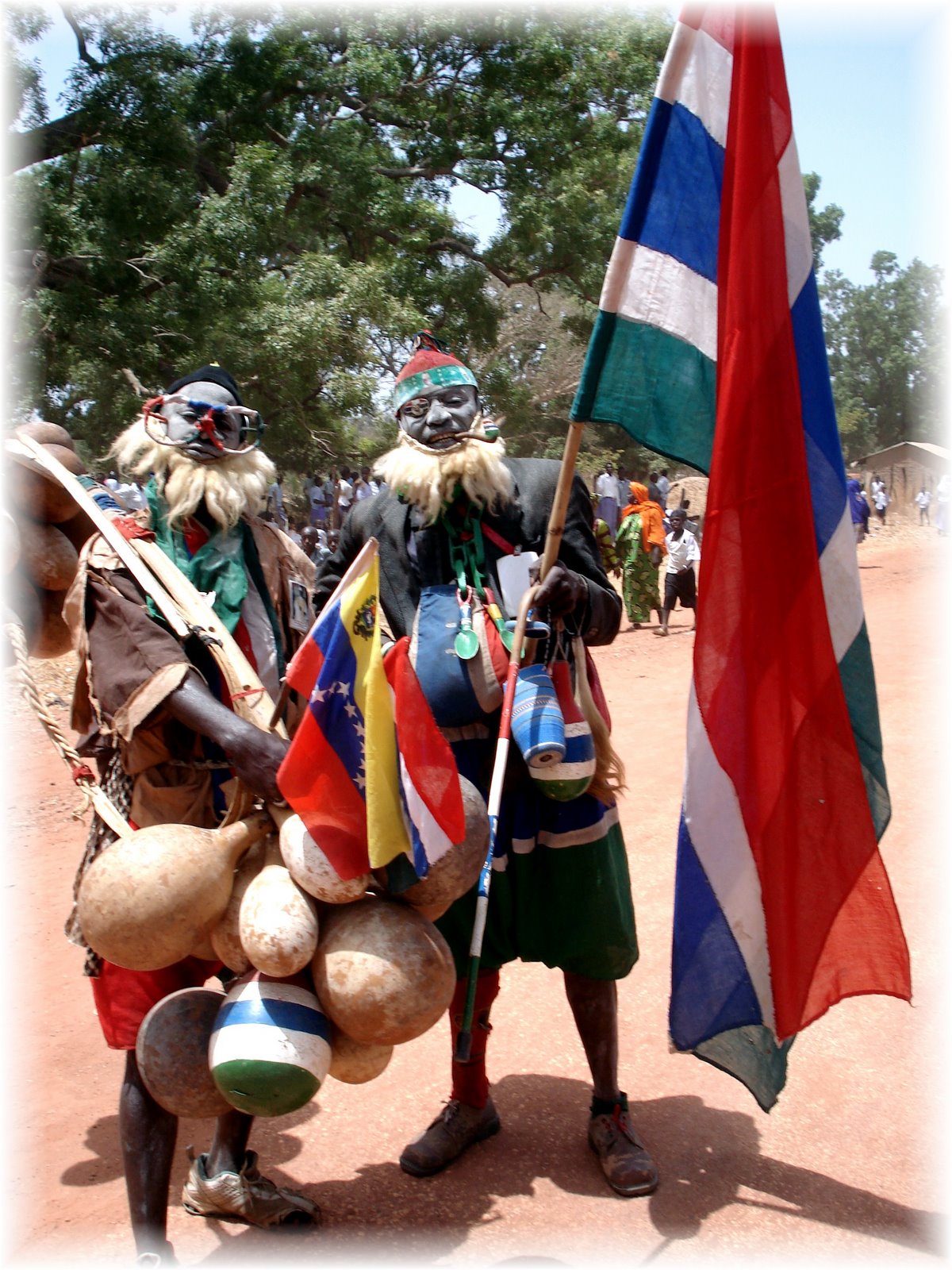
The President came to town last month. He is an interesting figure. Perhaps you have heard of him. He is the man who believes that he can heal HIV/AIDS by rubbing oil on people’s bodies and has publicly said that any homosexuals found in The Gambia will be beheaded. He was making a tour of the country and stopping at various towns along the way. This man travels in style. Long, black armor-plated Hummers, military men and artillery spread out in a sea of camouflage on the road in front of and behind him. People here love their President though and so turned out en masse to dance and sing and hear the speeches. My group of beekeepers carried a KTB and a traditional grass hive up to Kalagi on a donkey cart so that we might get some exposure. Schools from all over the Fonis came, women and men who never leave the village made the trek to see the President. I got there in the morning and nobody knew when to expect him so I mingled for a while on the dusty road with clowns and school children. Some Jola women were singing and I decided to make a short video of them. (I have made a lot of videos here and will put them on YouTube so you can view them. Unfortunately, the connection is slow and uploading takes forever so I’m sending them to some friends back in New Mexico who have a fast connection. When they are up, you’ll be the first to know.) I videoed the women for a while then panned across the crowd at the Bintang Bolong bridge that the President’s parade would cross over. Instantly and before I knew what was happening a paramilitary man all in black with a hefty pistol and mean look on his face filled my viewfinder with his hand and took the camera away from me. He was manhandling it trying to turn it off while I protested. He would not give it back and threatened to throw it on the ground if I didn’t shut it down. So I asked for it so I could turn it off and then promised to put it away. He gave it to me reluctantly and informed me with the air of authority that his position had given him that cameras were prohibited when the President was around. But he wasn’t around I told him. But I was just taking some pictures of the people assembled to welcome him. “You should leave the territory.” He told me. But I was invited here and I came with friends. “If you don’t leave right now I will fuck you in the ass!” Now I was shaking and many people were watching. He grabbed my arm as I struggled to put my camera away and he started to drag me. I wasn’t putting up much of a fight. I just kept saying “I’m Peace Corps. I live here. These are my people.” But he wasn’t hearing it. “Leave now. You are not welcome here. The President is coming and I don’t want to see you. If I see you I will beat you.” I didn’t want to go of course but I also didn’t want a beating… or anything else that he was offering. “Doubletime! I said move!” He was shoving me and marching me while all of the people of Foni Jarrol looked on and I kept wondering how this incident would affect my credibility within the community. Finally I was back in town away from the bridge and I could tell that the President had arrived because of all the cheering and the sirens. Suddenly, the paramilitary man was gone and I was trying to decide what to do. Then I saw my PC friend Nick who was passing through on his way to Kiang and got stopped for the oncoming motorcade. He could see that I was frantic and so I told him the story amidst all the revelry and commotion. Then I noticed that there was an army man directly behind me. He searched my bag and then heard my story. He said I could stay and that I shouldn’t take any more pictures. I said I wouldn’t and he disappeared into a sea of camouflage. I spoke to the local police who confirmed that I could stay and that if I had any other trouble I should come to see them.

The best part of the story is that the President saw the beehives that my friends had brought and offered to buy 300 of the grasshives. I was thrilled because it’s a great way for them to make some money. Also, only two men there know how to make them so we will have to be taught. This translates to skills transfer, income generation, and community project which are all watchwords of Peace Corps and important to me as modes of development. I am so proud to see this happening and feel like this is an important step for the Mangana Agroforestry and Beekeeping Association.

I found a dead donkey’s skeleton in the bush last month. I brought the sun-bleached bones home and pounded them with a large wooden mortar and pestle and then shook the dust through a screen to make bonemeal. People walking past my house came over to see what I was doing because Gambians who pound millet everyday get a big kick out of watching toubobs try it. They had never seen such a thing and several women helped me for a while. I explained the NPK needs of plants and told them that bonemeal would add phosphorous and calcium to the soil stimulating root growth, flower development, and overall plant health. I told them that I would mix the bonemeal with wood ash (equal amounts) and then apply the blend to the soil as a plant fertilizer. Wood ash adds potash (potassium- the K in NPK) to the soil which enhances the plant’s ability to retain water, increases crop yields, and improves the plant’s resistance to disease. These will be applied to the base of the plant once it is six to eight weeks old. Prior to that, I am using human urine for the nitrogen needs of the plant for vegetative growth. Peace Corps The Gambia is promoting human urine as an organic and inexpensive fertilizer. I fill a 20 liter bidong one quarter of the way with water then pee in it until it is half full. This takes about a week. Then I top it off with more water and keep it sealed to prevent ammonia release. I leave it for one week then apply it directly to my plants for both foliar and root feeding. Chemical inputs are expensive, unavailable, and not very good for the soil. By making fertilizer from urine, bones, and ashes I am providing all the basic needs for my plants without having to resort to something I don’t want to use.

So I guess that’s about it. Other stuff too but as always I have to get going back to site and I am trying to get this posted before I go. I hope that you are all well. I hope that you are growing something and that it makes you happy.