Showing posts with label permaculture. Show all posts

Saturday, September 19, 2009

Red Monkey, Stinking Blobs, and Giving-Up on Not-Giving-Up

I am a little more than two months from being finished here. Where did the time go? And why has it taken me so long to write this entry? Followers of my blog have probably notice a marked decline in my entries. I wish that this would just flow; I wish that I could easily describe how I've been feeling. But it is remarkably complex. Being here. Leaving here. Telling you about being here and about leaving here. Maybe I should start by telling you about the hardest part of leaving: I'm not all that sad about leaving. Which, truth be told, makes me extremely sad.


I thought I would be sad when I was finally finished here. I wanted to be. When I signed up for Peace Corps, I wanted so much to be here. But now that I'm about to leave, I am equally as ready to go. That's probably not so difficult for you to understand. Twenty seven months is such a long time to live like you're camping everyday and every night. Such a long time to have crotch fungus that spreads from your nipples to your knees. Such a long time to miss your best friends, the birth of your niece, and the aging of your family. Such a long time to feel like you're failing, to feel like you are an outsider, to miss almost all of the jokes. Such a long time to smear the words across the sweat-soaked pages of your nightly journal entries. Such a long time to take weekly antibiotics to prevent malaria, to have no privacy, to be called a name that isn't yours.


A few nights ago, I was walking home in the dark and the rain had soaked me until I was shivering in spite of the humid heat. My leather sandals were disintegrating beneath my feet as I waded through ankle-deep puddles of mud and sewage. I fretted about the diary and electronics stashed in plastic bags inside my pack. Forty minutes after getting out of the rattletrap gelegele that had brought me to the outskirts of Gunjur, I finally made it home. My stomach had been churning for a while and I began to rush with the key to let myself inside. I shoved the door open and dropped my pack on the floor trying to get through my house to the pit latrine out back. My knees shaking, my thighs clenched, my stomach rolling I tripped over my pants trying to get out of them. I lurched out of the house naked from the waist into the rain but before I could get to the hole in the ground I shat all over myself. Stinking blobs ran down my legs and splattered at my feet. I slipped in one and fell to my knees. It kept coming and I kept going.


I came here for so many reasons. Many of those have long been forgotten, modified, and rearranged. Some were always unattainable and others were just plain absurd. But I never expected to be in these types of situations where I feel so physically and emotionally unhealthy. I came here because I wanted to see another part of the world yet, because of the conditions here, my world is smaller and more confining than it has ever been. I wanted to have an adventure, but living in a developing nation is often boring, slow, and mundane. I wanted to learn about a different culture. When in my own culture, I am free to reject the things about it I don't agree with. Here, I am obligated to remain "culturally sensitive" and non-judgmental. They tell you that Peace Corps will change you in ways that you never expected. I didn't used to, but now I get annoyed with people who constantly beg money from me. I didn't used to, but now I am skeptical of people's intentions. I didn't used to, but now I can't seem to write what I feel, can't seem to describe what this experience is like, can't seem to articulate my thoughts.


I didn't used to, but now it seems I've lost my sense of humor about this place. Now I am taking myself too seriously. Why? I was sitting today in meditation after a long session of yoga and I couldn't stop myself from feeling like I need to be more creative and open about my experience here. I keep feeling like I am losing something, someone, somehow. My head kept going back to it even as I tried to clear my mind and eventually I gave up. But how do you-- how can I-- just give up? The voice in my head kept telling me to laugh yet it was all I could do to keep from crying. These changes can't be avoided. I need to let go and relax and allow things to unfold. Why do I seem to be resisting everything that comes up? Friends leaving, projects ending, relationships shifting. Homeless, directionless, focus-less. Maybe this is the problem. Maybe it's not the here and now that is scaring me so much, leaving me so speechless and perplexed. Maybe it is what comes next that I am so worried about. Seems like, when I go back and reread many of the entries that precede this one, I was so excited and amused about this place because I was (mostly) fully here when I wrote them. But now I am so enwrapped in tomorrow that I can't focus on today. Ever since I decided that I wouldn't extend my service here a couple of months ago and started to think about leaving at the end of November, I am increasingly anxious about leaving.


I don't want to write right now that I've failed here. But haven't I? So many people told me that I would love this place... I've let them down. So many people said that I would really make a difference here, I have failed them too. Because I sometimes fail at cultural sensitivity, I feel like a failure when I don't agree with certain norms and behaviors. I wanted to be fluent in the local language, to improve someone's life, and to (somehow) find myself. Most of all then, haven't I failed myself? But I don't want to write about failure because it sounds so melodramatic, so self-deprecating, so un-happy. And that isn't quite at all what I wanted to write. Which is why, I think, that I haven't written for so long. Is wanting to leave-- is giving up-- failure? Or should I finally accept that it is time to go? Can I accept that I've done what I could and nothing less? Can I believe in myself that I gave it all my best? Now that it is finishing, there is nothing wrong with putting more into leaving than staying.


In the government-speak of the US Peace Corps, they call it Close of Service (COS) and it is more difficult than anything else I've done since submitting my application way back in the fall of 2006. COSing involves slowly withdrawing yourself from the relationships you've created. It means preparing to do something totally different somewhere completely away from here. It requires giving your projects over to somebody else and trusting that they will care enough to keep working on it once you've gone. COSing is about medical checks to make sure you aren't carrying some heebee-jeebies away with you, means completing hundreds of forms to quantify the work you did and the impact you had, and forces you to say goodbye to the people who have become your family. The Gambia is far from anywhere I plan to be in the near future and so I have to accept that this sort of life is something that I am also moving far from. The good and the bad.
Sure, I am looking forward to no longer living in a mud hut with no electricity and water pulled by hand from an open well contaminated with amoebas and gecko poop. I can't wait to no longer rely on dangerous and undependable local transport to get me where I want to be. I am so happy at the prospect that I might go somewhere and make some money and stop living hand to mouth with some of the poorest people in the world. But I am also saddened that I might never see most of these people ever again, won't have the Atlantic coast as my backyard, will no longer live among monkeys and monitor lizards. What will happen to the little girl who lives in my compound (I guess I actually live in hers) and still calls me the generic "Toubob" instead of (my Gambian-given name) Laamin or (my preferred) Matthew? How will things continue with the beekeeping projects I've started? Will the mango and cashew and moringa trees I've planted survive to bear fruit? When will I next see the Volunteers I swore-in with and how will we all have changed? Will things work out between Tammy and I once we are in "the real world"? This process is sort-of about giving-up; no wonder I am so apprehensive about it. Most of my friends are facing similar anxieties about leaving here.


A few days ago I wandered into the small Mauritanian-owned shop near my house to buy some eggs and bread for breakfast. There was a young woman standing at the counter and she instantly struck me as different than most of the Gambian women I see. Her head wasn't covered, her wrap-skirt was printed with cannabis leaves and Bob Marley icons, and she carried herself in a way that was, well, different I guess than what I've become accustomed to. The most remarkable thing about her was the unlit cigarette hanging from her mouth. Gambian women simply do not smoke. I guess I sort of was staring. She caught my gaze and scowled and then did something I didn't expect: She called me out on it. "What the fuck are you looking at? Never seen a nigger before, you Red Monkey?" I gulped and swallowed my embarrassment. I felt so strange all of a sudden. Usually I'm the one being stared at, feeling the scrutinizing gaze of some stranger. "Sorry. " I stammered feeling unsure of myself. "I was just standing here." She scoffed and turned her back to me and I walked out of the shop without my breakfast. Later, I told a few friends about the exchange and wondered why she was so angry. I thought about this damned Peace Corps life and felt sorry for myself, singled-out, and abused. I've come all the way to Africa to live like this (the constant itch of heat rash, the lack of intellectual stimulation, the inconvenience of it all) and the people who I've come to help treat me this way. I finally decided to just forget about her, forget about the weird exchange. It wasn't, after all, indicative of the way I am generally treated by Gambians. These people are usually some of the nicest I've ever met. Most Gambians will invite you to share in their meals, to live in their compounds, and to sample their lives. I should know better than to let one bad experience temper the way I actually feel about Gambians on the whole. Maybe she was just having a bad day.
And then last night I wandered alone into a bar near here to buy a beer. As my eyes adjusted to the dim room I noticed three men gathered around a woman-- the same woman-- and laughing drunkenly. She was dressed this time in a pink halter-top, a leather miniskirt, and high-heel shoes. And then it struck me: She is a prostitute. This time I averted my eyes immediately and wondered if she remembered me from that day a week ago. I half-expected her to call me out again in front of the drunk men. I even considered asking "Are you still so angry at this Red Monkey?" But then-- standing in this stinking place with peeling paint and broken furniture, standing in this third-world heat and humidity, standing waiting for my beer avoiding the gaze of angry prostitutes and their sorry clients-- I didn't say anything at all.


What did I want from this damned Peace Corps experience that I haven't gotten? I wanted to leave the USA and see something different. I wanted to challenge myself to learn a language. I wanted to have something to talk about. I wanted to meet new people and make new friends. I wanted to apply myself to the thrills and tests of the life-less-comfortable. I wanted to expose myself to African culture and customs. I wanted to learn about pre-industrial agriculture, permaculture, and beekeeping. I wanted to boost my résumé and improve my chances of getting into a decent graduate school. I wanted to travel. I wanted to simplify my life, to live without the modern trappings and conveniences, and to decrease my carbon footprint. I wanted to broaden my horizons. I wanted to put some things behind me.
I think it is finally time to leave here. Yesterday, a friend of mine who is also leaving soon asked me "What did you think Peace Corps was going to be like when you signed up?" I thought for a moment and then met his gaze. "Exactly like this."

Wednesday, January 21, 2009

Mi weltima hitande hesere!


After my parents returned home I was excited to get back to work. I returned to my village where I jumped into a few projects around the compound. My Host Brother Landing had finished threshing the groundnuts and we bagged them for storage. Some will be saved for next year's seed and we will eat the rest in rice dishes such as nankatan, maffe gerte, and gosi. From a single hectare field of groundnuts planted in July, we harvested nine sacks in November.


I helped Gallo and his family make blocks to rebuild the walls of his house that had collapsed during the rainy season. Altogether, we made 4000 mud blocks. For ten days five men and eight boys hauled water from a pump, dug mud with short-handled shovels, and formed sun-baked bricks.


My garden is a work in progress. I've designed a permaculture "guild" in the back corner of my demonstration yard. The tall papaya provides shade for the squash and tomato seedlings while the shorter pigeon pea will fix nitrogen. The trees were planted during the rains in August.


This almond tree is benefitting from the urine fertilizer I've been making. I apply about five liters of a diluted solution twice a month. The tree is very healthy and vibrant.


This ebony tree is also doing well. I keep it mulched with the chaff from groundnuts and millet, broken stalks, and small sticks. The chickens scratch at the moist soil so I have woven the very prickly branches of a winterthorn atop the mulch. I've used biochar and compost in all of my planting holes.

I harvested some of my sweet potatoes. They were planted in September on small hills in my back yard. I intercropped them with beans.


I'm really excited about the biochar projects I have going. Biochar is a soil amendment that is credited with contributing to the fertile soils of the Amazon. I collect the un-sellable dust and detritus from abandoned clandestine charcoal production sites in the bush. The government of The Gambia outlawed charcoal production twenty years ago as a measure to protect its dwindling timber resources. Because of the remote location of my village near the border with Cassamance, many people still engage in charcoal production.


My friend Bakary Jatta makes biochar using a gassification system. It is a clean and efficient way to make charcoal: Bakary uses crop residues and slash from his jatropha plantation. This process eliminates most of the carbon emitted into our breathe-o-sphere and retains more than 50% of the original biomass. The biochar is then mixed with the flotsam from Bakary's biodigester and finely chopped yard waste to create a productive planting medium.


Bakary came here 1984 from Canada to work with St Joseph's Family Farm in Bwiam. He promotes jatropha as a cash crop. It is a small bush that grows well in this sub-tropical sahel environment. The nuts from jatropha are pressed and the oil can be used for candles, cooking flames, and soaps.


People from eight villages in Foni Jarrol attended the Feed The Minds sponsored Free-Bee rural training. We've been traveling around the country for the past four months trying to spark an interest in beekeeping. This two-day workshop was held at the NBAG/Concern Universal Brumang Processing Center near Kalagi.


We informed the participants about pollination, seasonal calenders, and potential income from small-scale beekeeping projects.


We also engaged them with practical instruction. We encouraged them to build their own grass hives which are inexpensive and efficient.


We are trying to get women involved in beekeeping. Currently, they have little role in the traditional practices of honey harvesting. We hope to inspire them to see some of the different ways that they can benefit from constructing hives, harvesting hive products, and selling value-added products at the weekly market.


I've also been working in the apiary at the National Beekeepers Association of The Gambia. This Kenyan Top Bar Hive was badly cross-combed and unmanaged. We are all terrified of it. Everytime Nick, Andy, Bah2, Kabee, or I go near it we just shake our heads and run away.


The combs had been constructed perpendicular to the topbars and the colony hadn't been managed since it showed up here three years ago. Finally we built up the courage to open it. We harvested honey and wax, corrected the orientation of the brood comb by wiring it to the topbars, and gave them honey from another hive to compensate for what we harvested.


Five days later and they haven't absconded.


Unfortunately, the bees from our observation hive did abscond. They had built several queen cells and eventually swarmed.


Once the bees absconded, wax moths moved in and quickly destroyed much of the wax. It happens...


Happy New Years. Mi weltima hitande hesere. I traveled to Fajara to wish upon the fireworks exploding over the beach.


New Year's Eve has always been my favorite holiday. I always make resolutions and this year was no exception. Mine: Instead of believing in nothing, I will make everything happen.


And so today begins my trip to Sierra Leone. I will travel for two weeks with my Peace Corps pal Jeff.


His old friend Ryan from back home is also traveling with us.


This blog post was the final thing I had to do before I could leave.


Now, it's time for me to hit the road.

Tuesday, June 3, 2008

Waiting For Windfall Mangoes


Fssst. Thump. Fssst. Thump. Laughter and fast footfalls. Ruminants gallop while boys dive. The elders assert their social standing. With each gust of wind another mango drops. First heard far away but quickly tossed from tree to tree until it tickles the branch you are poised beneath. The wind in the leaves high above finds that fruit that wasn’t quite ready with the last gust. Fssst. Thump. Necks twist and sprints are broken. Fssst. Shouts and giggles and laughter and cries of pain. Thump. The ripe fruit and a puff of dust: an orange flame in the drab dirt. The face of my Gambian village stained orange on its cheeks and chins. Stringy bits stuck between the teeth. Every hungry creature licks the lips and chases the fruit. Clouds of brown kicked up as the children race and chase for the… Fssst. Thump. Early in the morning we are called from our beds by night-cool fruits. The first afternoon breeze drops a piping hot mango pie at our feet. By the time the evening winds blow, the fruit- like us- has cooled. Fssst. It is not knowable which is the more welcome refreshment. Thump. The burst of the mango or the breeze that dropped it. Each of us is certain though that this is the sweetest bite that will come all year. Waiting for windfall mangoes.

This month brought many surprises- many treats and one minor threat.

A big congratulations is in order for my brother in Columbus, Ohio and his wife. They had their first child, a healthy baby girl named Amelie Sophia. It makes it hard to be here sometimes because I am missing some important moments in the life of my family back home. I am very happy for you Nate and Caroline.

The first rain I’ve seen in eight months came just a few days ago. I was on my bike on a windy morning about fifty kilometers from home and I was praying for rain. I had just spent the last five days on trek in Kiang with my Peace Corps friends Nick and Rob conducting beekeeping training. We rode from village to village meeting beekeepers and showing them some of the techniques we’ve been experimenting with. Mr. Bah2 from the National Beekeepers Association of The Gambia (NBAG) had set up some of the meetings. We demonstrated Kenyan Top Bar hive baiting and post-harvest wax rendering to more than thirty beekeepers. The initial results were seen when several hives that we baited were colonized within days. This is in spite of the fact that now is the beginning of the dearth period when bees are less likely to be on the lookout for a new home. Another highlight: We showed a man how to clarify his beeswax and he turned it into hand-cream and made over 500 dalasis. Also we talked with beekeepers to learn from them and I was shown a grass that is burned near hives because the smoke works as an attractant. We walked around and observed many different apiaries and helped a few people place their hives. Nick bought some woven-grass hives from a man for 100 dalasis each.

Finally, I had to return home but I had a bit of a coughing and wheezing thing going (seems like whenever I travel in The Gambia I hack up a lung) so I was feeling a bit slow and travel-worn. There was a headwind and sweat kept dripping from my helmet into my eyes. I was moving in slow-motion through villages, bush, and open fields. It is becoming planting time here in The Gambia and so men are slashing dried weeds and burning crab grasses. Many people are out preparing the dry rice-lands with machetes and digging sticks. A cool drop fell to my arm and I instantly registered it as something other than salty perspiration. Then another. And another. And then the electric scent captured my nose with a remembered tickle from some far-away olfactory memory. Rain was in the air. First I had felt it, then I had smelt it. Naturally I had to taste it. I stopped my bike on the red-dirt road and looked into the hazy distance. There was rain falling all around me; my clothes- which were already wet- became soaked. The wind was cooling the air and the trees were sipping from their leaves the first dusty drink of the rainy season. I did too.

It rained only about ten minutes. The road soaked up the water and left no evidence that it had ever fallen at all. I sniffed the air for every last lingering proof like the perfume of every pretty girl gone but never forgotten.

(Sorry about that. Rain and pretty girls are undeniably poetic in my world.)


So, I was sitting on the bamboo bantaba in my compound one morning a few weeks ago talking about soldiers with my friend Sanna. Suddenly he spotted a small animal running across a burned field just beyond the village and he smiled hugely. “Laar wandu ngessa toon!” he said and I looked at the monkey over there in the field. A few days before, he had asked me if I would eat a monkey. I said that I would and told him the story about when I ate one last February that some Mandinkas had charred. He said he wouldn’t eat one because it looks too human but that if he saw one he would shoot it for me. He saw this one and was instantly calling for his mutt and racing to his house for his rifle. He was back in an instant and we went running to the chewe’ trees- chasing the dog that was chasing the monkey. We arrived at the grove and craned our necks skyward searching the canopy for the treed primate. I sent up a silent wish that somehow Sanna would miss even though I knew he wouldn’t. What was I doing? I had no right to hunt this monkey just because I’ve been eating nothing but rice for weeks. Maybe he’ll miss. A crack went out as he shot and then silence. We each breathed up into the leaves and dappled sunlight. Nothing. He must have missed. He wouldn’t miss again. The monkey lunged from one tree to the next with a graceful jump and looked down at us. My eyes locked with hers. I knew exactly what she did. There was no way out. Even if Sanna missed this time, eventually somehow she would fall. The rifle blasted and the monkey fell and the dogs lit upon her and I looked away. She was dead before she even hit the ground.

Sanna and I took the monkey home passing through the ranks of people staring and grinning. Few people here eat monkey and I knew right away that I would be on my own with this thing. We took her home and my host-mom asked what we were going to do with it. We scared my host-sister and fascinated the children. Finally we took the carcass to my back yard and strung it from a leuceana tree. Sanna offered to skin and gut it for me since he knew that I didn’t know how. Once he was done with that though he left me on my own to cut away the meat. I worked for an hour to free the meat and I decided that I agreed with the townsfolk. Monkey looks a lot like human. But once it was finished it tasted an awful lot like beef. I marinated the meat in olive oil, salt, and spices for about three hours. I made a mango, onion, and tomato chutney from local ingredients. Finally, I braised the meat over an open fire and reduced the sauce until it was thick and served it over rice. My host father refused to try any at all but the rest of my family each had a few bites and told me that it was weli (sweet.)


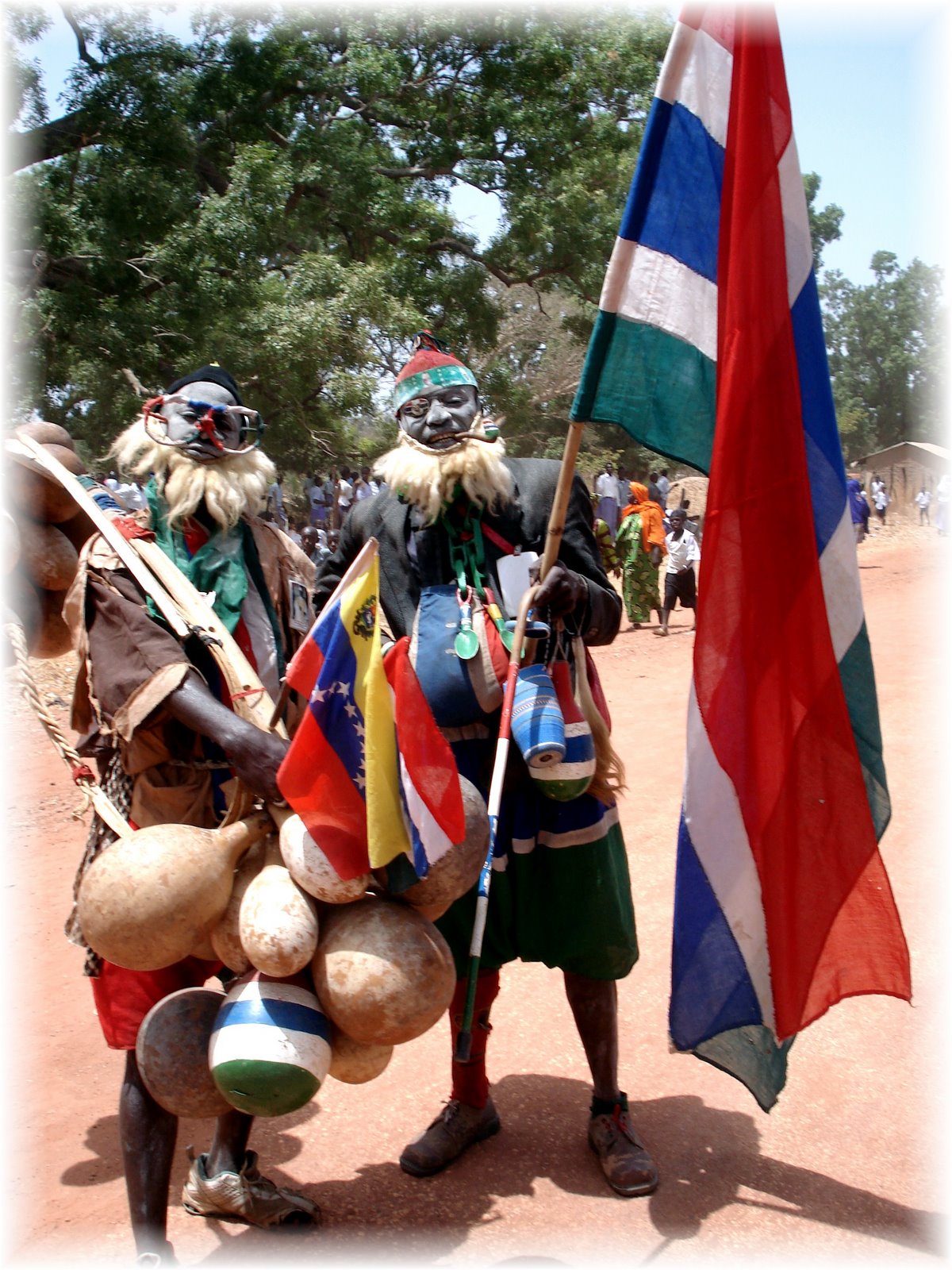
The President came to town last month. He is an interesting figure. Perhaps you have heard of him. He is the man who believes that he can heal HIV/AIDS by rubbing oil on people’s bodies and has publicly said that any homosexuals found in The Gambia will be beheaded. He was making a tour of the country and stopping at various towns along the way. This man travels in style. Long, black armor-plated Hummers, military men and artillery spread out in a sea of camouflage on the road in front of and behind him. People here love their President though and so turned out en masse to dance and sing and hear the speeches. My group of beekeepers carried a KTB and a traditional grass hive up to Kalagi on a donkey cart so that we might get some exposure. Schools from all over the Fonis came, women and men who never leave the village made the trek to see the President. I got there in the morning and nobody knew when to expect him so I mingled for a while on the dusty road with clowns and school children. Some Jola women were singing and I decided to make a short video of them. (I have made a lot of videos here and will put them on YouTube so you can view them. Unfortunately, the connection is slow and uploading takes forever so I’m sending them to some friends back in New Mexico who have a fast connection. When they are up, you’ll be the first to know.) I videoed the women for a while then panned across the crowd at the Bintang Bolong bridge that the President’s parade would cross over. Instantly and before I knew what was happening a paramilitary man all in black with a hefty pistol and mean look on his face filled my viewfinder with his hand and took the camera away from me. He was manhandling it trying to turn it off while I protested. He would not give it back and threatened to throw it on the ground if I didn’t shut it down. So I asked for it so I could turn it off and then promised to put it away. He gave it to me reluctantly and informed me with the air of authority that his position had given him that cameras were prohibited when the President was around. But he wasn’t around I told him. But I was just taking some pictures of the people assembled to welcome him. “You should leave the territory.” He told me. But I was invited here and I came with friends. “If you don’t leave right now I will fuck you in the ass!” Now I was shaking and many people were watching. He grabbed my arm as I struggled to put my camera away and he started to drag me. I wasn’t putting up much of a fight. I just kept saying “I’m Peace Corps. I live here. These are my people.” But he wasn’t hearing it. “Leave now. You are not welcome here. The President is coming and I don’t want to see you. If I see you I will beat you.” I didn’t want to go of course but I also didn’t want a beating… or anything else that he was offering. “Doubletime! I said move!” He was shoving me and marching me while all of the people of Foni Jarrol looked on and I kept wondering how this incident would affect my credibility within the community. Finally I was back in town away from the bridge and I could tell that the President had arrived because of all the cheering and the sirens. Suddenly, the paramilitary man was gone and I was trying to decide what to do. Then I saw my PC friend Nick who was passing through on his way to Kiang and got stopped for the oncoming motorcade. He could see that I was frantic and so I told him the story amidst all the revelry and commotion. Then I noticed that there was an army man directly behind me. He searched my bag and then heard my story. He said I could stay and that I shouldn’t take any more pictures. I said I wouldn’t and he disappeared into a sea of camouflage. I spoke to the local police who confirmed that I could stay and that if I had any other trouble I should come to see them.

The best part of the story is that the President saw the beehives that my friends had brought and offered to buy 300 of the grasshives. I was thrilled because it’s a great way for them to make some money. Also, only two men there know how to make them so we will have to be taught. This translates to skills transfer, income generation, and community project which are all watchwords of Peace Corps and important to me as modes of development. I am so proud to see this happening and feel like this is an important step for the Mangana Agroforestry and Beekeeping Association.

I found a dead donkey’s skeleton in the bush last month. I brought the sun-bleached bones home and pounded them with a large wooden mortar and pestle and then shook the dust through a screen to make bonemeal. People walking past my house came over to see what I was doing because Gambians who pound millet everyday get a big kick out of watching toubobs try it. They had never seen such a thing and several women helped me for a while. I explained the NPK needs of plants and told them that bonemeal would add phosphorous and calcium to the soil stimulating root growth, flower development, and overall plant health. I told them that I would mix the bonemeal with wood ash (equal amounts) and then apply the blend to the soil as a plant fertilizer. Wood ash adds potash (potassium- the K in NPK) to the soil which enhances the plant’s ability to retain water, increases crop yields, and improves the plant’s resistance to disease. These will be applied to the base of the plant once it is six to eight weeks old. Prior to that, I am using human urine for the nitrogen needs of the plant for vegetative growth. Peace Corps The Gambia is promoting human urine as an organic and inexpensive fertilizer. I fill a 20 liter bidong one quarter of the way with water then pee in it until it is half full. This takes about a week. Then I top it off with more water and keep it sealed to prevent ammonia release. I leave it for one week then apply it directly to my plants for both foliar and root feeding. Chemical inputs are expensive, unavailable, and not very good for the soil. By making fertilizer from urine, bones, and ashes I am providing all the basic needs for my plants without having to resort to something I don’t want to use.

So I guess that’s about it. Other stuff too but as always I have to get going back to site and I am trying to get this posted before I go. I hope that you are all well. I hope that you are growing something and that it makes you happy.

Sunday, April 27, 2008

April 15

Another month in village (where things are starting to heat-up, in more ways than one) and now back to Kombo for the Agroforestry In-Service Training (IST) and to cheer on the new Health Volunteers who are swearing-in this week. Seems like only yesterday that that idealistic and enthusiastic young Trainee was me- obsessing about language, culture, an all-rice diet, and the heat. Well, I still worry about all those things. And plenty more that hadn’t yet even occurred to me then. But nevermind. Now I give them my best wizened look, scratch at some incessant bug-bite, and tell them that they’ll be just fine.

As I write this I am perched high above Fajara where an ocean breeze cools my espresso on the balcony of Timbooktoo, the bookstore and café where wireless internet is free with any purchase. Gambians love their Nescafe’ and its hard to find a good cup of coffee anywhere but there are two places I know of in this country that offer the finer things.

When will I learn to trust my woman’s intuition? (Mine I mean, I have no woman and she has no intuition). I knew I had to be in Kombo by Tuesday morning for a meeting at the Forestry Department and last Saturday I began to feel like I should not depend on things going smoothly. Two of the three gelegeles that leave from my neck of the woods have broken down along the road somewhere and haven’t been seen for weeks which left me counting on Molafi for my transportation to Kombo. On Saturday I went to his house where his kin assured me that he would be going on Monday. Inshallah. If Allah wills it, he will go. So on Monday morning I awoke at 5:30 and hefted my duffel of clothes and my burlap sack that I had sewn closed after stuffing with three beesuits, three pairs of boots, and all the tree seeds I’ve collected for the IST seed exchange (winterthorn, moringa, yellow cassia, flamboyant, pigeon pea, and pignut). I am building my neck muscles and so was able to carry one bag on my head like any good Gambian would, the other slung over my shoulder American-style. I hiked about four kilometers through the rice field before the cocks crowed but the bees were already awake and I could hear them in every gmelina I walked under. When I arrived at Kangsambu the aparante (boy who rides in a gelegele and negotiates tying the goats to the roof, haggling fares, and stuffing as many sweating human animals into a dusty metal box as physics will allow) was scratching his head looking forlorn at the flat tire. I knew it. Luckily, they had a spare. Unluckily, as soon as the thirtieth person climbed aboard in Kangsambu we began to hear the telltale hissing sound from said spare. We all climbed out and the aparante borrowed a bike pump from someone but it was mostly ineffective (due of course to the hole) so Molafi rigged some sticks to the rear forks of a borrowed bicycle and sent the boy with the flat tire to Kalagi (at least ten k away) to get it repaired. We sat in the dirt. About three hours passed and then Molafi threw my rice bag to me from the roof and told me that we’ll go tomorrow inshallah. So I humped all my stuff back home where my host family had a chuckle. But I couldn’t give up so with the help of my host-brothers’ wives Fatou and Syrah, we tied my bags to my bike with the shredded inner-tubes that are used as straps here and I set off on a wobbly and precarious ride to Kalagi. There I left my bike in the hands of some local police officers who, with a disturbing wink and grin, assured me that they’d take real good care of it. I’ll be surprised if I will ever see it again. Then I went to sit along the main road with about thirty other travelers with burlap sacks and waited in the sun and the dust. Because it is a police checkpoint, all vehicles are required to stop whereupon the riders are accosted by young girls hawking bananas, coconut slices, and plastic bags of water and the aparantes by stranded nomads who insist “Sure, you can squeeze me in right next to those chickens and sheep. Come on.” It took a while before I really asserted myself but I realized that if I didn’t push and shove like everyone else I’d be sleeping right there that night and I eventually got aboard an already crowded vehicle coming from further up-country. We eventually were impeded by a flat tire in Sibanor and then eventually made it to Serekunda where I eventually caught a taxi to Latrikunda and then another to --eventually—Fajara, my destination.

Things at site have been up and down this month. Most of my fellow Volunteers are experiencing the same. Gambians love to say “it is not easy.” Nothing is. I’ve been really experiencing some difficulties at site with the work that I want to do. For example, I have a hammer. Not many people here have hammers. Ali Dado asked to borrow mine and when he gave it back twenty minutes later it was in five pieces. How do you break a tine from the claw, the head from the body, the body from the handle, and the handle into two pieces? If you asked me to break a hammer and gave me six weeks to do it I’d be lucky to make it into two pieces. I had called a workday at the womens’ garden for the following day to repair the fence so that all the hungry cows, sheep, and goats wouldn’t be able to eat our modest crops. So I showed-up ready to pound fence nails with a rock. The garden is a total loss.

But I cannot totally blame that on the hammer. All gardeners no matter where they live struggle with nature and Gambians are no exception. Pests, climate, soil, germination, weeds. All these and more. The Gambia is a tough place to grow food. The sun is hot. Nange na wuli wut! Things dry out so fast and even the warm season and drought tolerant vegetables I was growing in New Mexico struggle to survive here. By 10:00am it is beyond hot and by noon the harmattan winds from the sahel blow whatever moisture there was to oblivion. Soil is actually sand and silt with no organic matter which compacts with watering to a state similar to cement. I am trying a mix of mahogany saw flakes and dried leaves as mulch to try to keep the soil cool and damp but I have to be careful not to attract termites which are a huge problem here. My tomato plants suffer from wilt and my cucumbers won’t grow fruit. The carrots are all stubby because they can’t break the compaction. Seeds that my family sent from America won’t even germinate. And then, if you can beat all of that, the local livestock will go through, under, of over any fence you can construct.

A few weeks ago while in the garden I noticed that there was a goat eating some woman’s bitter tomato plants. I chased him with a stick and he ran out of a hole in the fence that I then repaired. The next day I noticed another goat and a sheep eating okra and eggplants. I chased them with dirt clods and they each went out through two new holes. I repaired those. The next day four goats, six sheep, and two cows. I chased them with sticks, clods, and a pitchfork. They evacuated through holes except for the cows who jumped over the four foot wire mesh and barbed wire fence that had been donated from NGOs Concern Universal and St Joseph’s Family Farm. Fencing in The Gambia is a big issue and one that agroforestry is trying to address. Local solutions include cutting bamboo or small trees for fences or twisting thorny branches or palm fronds together to try to keep the animals out. Livestock range the bush and most herders could never supply supplemental food for their animals. Because of this they are malnourished and insistent. The goal of the herdsmen is to keep the livestock alive through the dry season and then fatten them when the rains come sometime in late June or July. Women garden in The Gambia while men raise livestock and farm millet and groundnuts. Because of this, the men do not really help the women with their gardening and so fence maintenance- which is no easy task- suffers. Here’s where agroforestry is trying to help. We are teaching about “living fences” which is the use of perennial species to create a thorny hedge or impenetrable barrier. Most of the Acacia species do well here once established, euphorbia and pignut are unpalatable to most livestock, and sisal is an Agave that can make a low-maintenance living fence. Of course all these require planning and investment which “is not easy.” People have a lot of priorities and trying to get them to think about planting seeds and nurturing trees through their vulnerable seedling stage is a difficult task. You need a fence around your nursery to keep the animals from devouring your young living fence propagates. It is simpler to cut garden fence material every year in order to repair the damage that termites, sunlight, and livestock do. Or, in some cases, an NGO might provide prefabricated fences but not the tools that are necessary to maintain them. I’ve watched helplessly as men try to cut barbed wire strands by bending them over and over until they break because they have no wire-cutters. This demonstrates how development can hurt sometimes; good intentions become obscured when the people lack the basic tools for maintenance.

So in addition to the livestock and other pests, to the sun and the wind and the drought, to the lack of soil fertility, another obstacle to raising food is the people’s attitudes and abilities. And here is where I feel absolutely unprepared as a development worker. I have spent the last few years studying food production in difficult climates, researching organic methods and permaculture systems, fraternized with extension workers and farmers. But sometimes theory and practice do not meet. Good ideas. I have a particular vision, I’m not at all sure that the people I am working with share in that vision. For one thing, I come from America where some of the best agriculture in the world is practiced because of fertile soil, chemical fertilizers and pest control, superior seeds, and government subsidies. There I have seen crops flourish and watched men make huge sums selling the fruits of their labors. Here, I am working with people who have never seen such things and so just imagining such lush fields might be beyond their capacity. It requires a huge leap and I am asking these Fulas to strive for something that they have never seen, to project themselves to someplace else, to another time either before the climate grew inhospitable or after they have re-nourished their soils with organic matter- which could take years. People here have always practiced slash & burn techniques. How do I convince them that burning fields in preparation for planting extinguishes the rare biota that remains in the soil and releases carbon into the air making it even more difficult to grow food? How do I encourage leguminous cover cropping when people invest all they have into basic staple crops ? How do I convince people that they need to change their practices when the language barrier prevents me from speaking creatively and making my points clear?

The men of my village told me last week that the rains last year came late and ended early and their harvests of groundnuts and millet were disappointing. Usually they save the best seeds for planting the next year but this time they ate everything and now they have nothing to plant. As I’ve described, I tried to get the women to help me repair the fence against the livestock yet they were unable and unwilling. The sun is hot and people are tired. Traditionally this is the time of year when they take a break from growing vegetables and so when the ruminants started to break through, the women gave-up and lost over a hectare of tomatoes and onions and cassava. It broke my heart to see that small patch of green reduced to stubble in less than two days.

Perhaps you’ve heard- climate change is making it hard everywhere to grow food. The World Bank and the Food and Agriculture Organization are all predicting that things in the developing world are only going to get worse. It is not easy. Over sixty percent of the people here survive on subsistence agriculture yet the problems with that lifestyle are compounding because of changes to the climate, to the economy, and to the culture. I am here because I want to help and these people have accepted me because they desire help. Sometimes though- lying sweating in my bed or watching crops whither away or seeing children with distended bellies of malnutrition- I wonder if I am failing them and failing myself.

Sorry about all the doom and gloom. There are wonderful times in The Gambia too. Recently there was a naming ceremony in my village. Ok, the story begins kind of sad but…

My friend Sanna and one of his wives had a little boy and traditionally Fulas wait eleven days before naming the child which takes place with a huge ceremony attended by friends and family from all over, the child’s hair is cut, people donate money for his well-being, goats are slaughtered, a griot will come and sing stories, people dance all night. A few days before the eleventh there was a death in our village, an old woman named Hawa passed away suddenly. The mandatory grieving period for the village is forty days and so the naming ceremony was postponed until after that. As the date of the event neared people started to arrive in my village. Houses began to swell with family members from all over, new faces (to me) were happy to be home. Some folks had come from a long distance and some had not been here for a long time. Sanna encouraged me to invite some of my Peace Corps friends so I invited Amber, Tim, and Becca who live reasonably close to me and could ride their bicycles. A dj was hired: Since there is no electricity he had to bring a generator to power the huge speakers and dual cassette players that he brought on a donkey cart. People were dressed to the nines with fancily tailored clothing and I noticed that there were a few new goats in town.

Saturday was the day of the naming ceremony- also the hottest day of the year so far. Amber and Tim rode in filthy with dust stuck to the sweat coating their bodies; Becca arrived later in much the same state. They took bucket baths behind my house then put on their best Gambian clothes. We wandered out and joined the party. The baby and his mother were on a blanket and women were holding a blanket over them which was blocking the sun and catching the coins that people were throwing. The griot was singing praises upon them and telling the genealogical history leading up to his birth. Jarreh is the man the baby was being named after and he was proudly shaking hands and giving small gifts to everyone who had come. He is a good friend to the Peace Corps Volunteers of the Foni District because he owns a small restaurant along the Bintang Bolong where we often meet for the only JulBrews available for many kilometers in any direction. The time came for the ceremonial cut and a man with a razorblade took a lock from the boys scalp and the cheer went up as the hair was handed to the mother (never let your own hair lie because birds are likely to pick it up and build nests which will cause you to have a terrible headache for weeks). Then the attention was cast to the man with a long knife and he cut the throat of one of the goats. Then another and another until five bleeding, twitching goats were strewn about in the dust. All the women went to the big cooking pots already steaming with rice and onions over open fires beneath the mango trees and the men set about butchering the goats. The party lasted all day with people getting to know one another and catching up. I met many new people and we sipped attaya and talked about local issues. When dinner was served I wandered from compound to compound and shared the food bowl with many people. Towards evening the music started and people danced until well into the next morning. Fulas love watching us toubobs dance and cheered us on as we tried to predict the exotic rhythms and sounds of the music. Finally we were exhausted and so went to bed in my home but we were all too tired to sleep so lied around in my hot house telling stories until the sun came up.

Another adventure occurred two weeks ago when I rode my bike 72 kilometers to visit Jeff up in Kiang. I left early to beat the heat and saw a huge bush pig on the road along the way. Kiang District is different from Foni District in many ways and it was rewarding to get out and see the changes in the scenery. He lives near the River Gambia so the landscape is unlike where I live due to the different plants that grow and the landforms that are present. I got to his house by 10:00am and was introduced to his family. They are Mandinkas so I was only able to communicate on a superficial level before Jeff would step in and explain that I was Fula and then try to translate what people were saying to me. We went for a bike ride to the village of Kemoto where boats were coming in with the day’s catch of shrimp, tiger prawns, and various tropical fishes. I had a great time talking with the fishermen because many of them were Fulas from Guinea so we were able to communicate. Some of them told me that they were wanted back home for various crimes, some were drunk (not all Fulas are Muslims), some were trying to make enough money to get home to their families. I felt an affinity for many of them: What adventure are we each on that takes each of us so far from home to stand together amongst tangled nets trying to tell each other the stories of how we came to be there? They were impressed with my Pulaar and showered me with praises. They gave Jeff and I some crabs and we bought fish and shrimp to take back to his family. I promised to return when they invited me to go out on a two or three day trip with them.

Later, Jeff and I took another ride and ended up at the Kemoto Hotel. Kemoto is a long way from Kombo by road but fairly easy to access on a river excursion. The hotel is a beautiful example of tropical gardens, tourist crafts, and traditional architecture right along the river. Today it is an abandoned ghost town beginning to crumble into the earth. The story I heard about the place from a friend of mine who used to live near there goes like this: A wealthy toubob investor built this hotel and another in Kombo in the Senegambia region where tourists often stay. His plan was that Europeans would stay in Senegambia for a few nights and then take a boat trip up river where they could spend the night in Kemoto before continuing on to Tendaba or Janjangbureh. Land ownership in The Gambian provinces is nothing like the real estate of the western world and so apparently the man signed a deal with the alkalo of Kemoto that if he built there he would bring jobs, electricity, and water (all the water near there is too salty to drink because of the River Gambia). The hotel is huge and probably could hold over a hundred guests and so the potential was big for the villagers. Unfortunately, as things go in The Gambia, the potential was never realized. The hotel encountered financial problems and finally declared bankruptcy. The people of Kemoto never saw the income generation promised nor did they ever get water and electricity. Eventually there was something of an uprising described to me as violent and the hotel was abandoned. (Let me again say that I have no evidence to support this story but Sulyman who told it to me seems credible.) Now there is a fence around it and a big security guard (with only one eye though) who is friends with Jeff so he allows him to collect cuttings and seeds of some of the plants growing there.

Jambundi. Compost, compost, compost. I build compost all the time and actually have four pits working right now comprised of leaves, grass, cow manure, fish bones, urine (my own), moringa, millet chaff, shrimp shells, wood chips, ash, eggshells, food scraps, banana plant stalks, and the sun-bleached bones of a donkey I found in the bush and pulverized. I remember my compost mentor- Jim bragging about being able to compost a horse and now I know what he means. You just have to make it into manageable pieces. I am preaching the virtues of compost everywhere I go for two reasons: First, the soil is depleted and exhausted and requires mass inputs of organic matter to try to balance the pH, provide nutrients, and facilitate water retention. Secondly, this is the first and easiest thing that gardeners can do to try to improve their yields as the time investment is short and the resources are all locally available. I offer classes to villagers and to students in two different schools. At one school I had asked the students what sorts of things we should put in our compost and after all the obvious answers one boy told me that monkey heads should also go in. People are interested in compost but it is difficult to get people to really invest themselves into the process. I think that one factor is that the gardeners use manure from small ruminants with some success. One problem with this practice though is that the manure adds mostly nitrogen which makes the vegetation grow so people think that they are doing what it takes. But plants need a complex of nutrients and trace elements which are underrepresented in manure alone and so while green leafy growth occurs, the plants lack what it takes to remain healthy and strong. Thus fruiting yields are low, the plant succumbs to the effects of sun and wind, and general weakness makes them very susceptible to disease and pests. Try saying that in Pulaar.

Three nights ago I dreamt that I was so happy with some compost that I had made that I started to eat it. As I chewed a big mouthful and admired the worms and slugs in the pile at my feet I realized that I shouldn’t eat it because of the manure. My breath stunk of cow shit. The mephloquine that we take to stave off malaria causes strange and vivid dreams and many Volunteers enjoy sitting around comparing weird stories. I keep a dream journal next to my bed and write in it almost every morning upon waking.

(Let me begin again. This is getting too long and its been twelve days since I first started it. Blogs aren’t compost, this should be short and current not a thesis-- for crying out loud.)

Tuesday, December 4, 2007

Training is Ending... Getting ready to Swear-In

Where do I begin? The Gambia, first of all, is an incredibly diverse and beautiful place- one that I am happy to call home. It is a place of contrasts, a place that is the eighth poorest in the world yet perhaps one of the happiest. The people are satisfied with what they have and they work hard to make a living. They are proud to give you some of their portion just for being here among them and for trying to learn some of their language and part of their culture. There are vibrant colors everywhere whether on peoples clothing or growing from the ground. Palm trees and baobabs- some thousands of years old- are scattered throughout the landscape. The climate attracts hundreds of species of birds including parrots, toucans, and gargantuan vultures (but I don’t think here we have hummingbirds). The children are joyful and resourceful: Its amazing the toys they can make from a broken sandal and a stalk of sugarcane. I have so much to learn about this culture and feel very happy that I have (at least) two years to study and participate. I have been made to feel highly welcome.

Peace Corps training is finally coming to a close. I will be sworn-in as a Volunteer later this week inshallah- god willing. My training group of 23 other individuals has spent the past three months learning one of several local languages, whether Wolof, Mandinka, or Pulaar. I fall into the third language group, that of the Fula ethnic group who are traditionally (and many remain) herdsmen and farmers. In addition to language we have also been versed in various aspects of Gambian culture including religion, history, and politics. We have been taught by Gambian “Language and Culture Helpers” who have been working with Peace Corps and the American Embassy for years. They are a knowledgeable and patient group of individuals who leave their families and come into the training villages up-country in the Kiang region where they live with us for several weeks to prepare us for the many challenges we will face.
We were split-up by language groups and each stayed with host families in small villages without electricity and running water where we attended daily language classes and interacted with the community. I have become good friends with many of the Gambians in the village where I lived with the Jallow family. My father was a hard working old man (few people really know their own ages here) named Sanna. I had many brothers and sisters who lived both within the community and throughout the country. I might someday meet someone that I have never seen before who will ask my name and then exclaim that I am his brother. Baa Sanna and Daa Sutay Jallow named me Laamin after their first born son who is a tailor in Serekunda. The Gambians remain a closely bonded group, though this is reportedly changing as the ideals of the western world intrude into their lives. Many of my neighbors are also family members. Now that I have visited my new family in my permanent village which is a considerable distance away, I have met many people who are “uncles” or “brothers” or even “fathers.”

In The Gambia, the family terms are quite different from those used in the US. This is partially because of the different roles that people play in the lives of their neighbors and families. For example, the children of one’s biological father’s brother are considered to be brothers and sisters while the children of one’s biological mother’s sister are also brothers and sisters. One’s father’s sister’s children or mother’s brother’s children are cousins. Because a majority of the Gambian population remains rural and “traditional,” a child will be cared for by many people throughout his or her upbringing. Because of the communal nature of these villages, many women nurse and care for babies and so it is logical that as that child grows up he or she might consider many women to be “mother.” Girls work alongside their grown-up female role models and learn how to behave through their observations and chores. Boys work with the men and so they refer to many different men as “father” because of the guidance role that these men take. Last week the headmaster of the local lower basic school introduced me to his eight different classes of children and he told them that he expected them to look to me as a parental figure. It is not to say that people do not know who their biological parents are as they certainly do. But because these communities are so tightly-knit, the family structure is considerably different than it is in the States.

My host family in training village and my host family in the permanent site are paid a small sum for their hospitality. I have agreed to pay my new host family- Baa Cheik Manne and his wife Daa Haddi- 600 dalasis per month for my living quarters, three meals a day, and laundry. I offered them more but because they want me to feel like a family-member, they would not accept it. At the current exchange rate of 20 dalasis to one American dollar, I am paying $30 per month for all of my basic needs which is enough to buy about one 50 kilo bag of rice. At a restaurant in the Kombo area which is the metropolitan center of this nation, a twelve inch pizza costs 175 dalasis and a beer 35 dalasis. It is easy to observe the differences between the rural villages where many Peace Corps Volunteers work and the city.

My new home is located in the Kiang West region of The Gambia about 150 kilometers from the coast. I am a fifteen minute walk from the border with Senegal and located in the corner of the country where the southern border makes a right angle to become the east. I will be about 170km east of Banjul and the rest of Kombo. All of my local travel will be by foot, bicycle, and donkey. Long-distance travel like into Kombo once every four to six weeks is by gelegele which is the way that almost everyone travels here. Gelegeles are large vans that seat up to 35 people- very tightly- and are artfully decorated with glitzy stickers and hand painted signs. You can wait all day standing alongside a dusty road for one to stop and pick you up as they each bump and bumble past so full that goats are tied to the roofs and people stand on the rear bumper. There is no guarantee that anyone will have room to take you and you might have to come back tomorrow if you really have to go anywhere. Once inside you will be squeezed between sacks of rice, squawking chickens, and children on the laps of their mothers traveling to wherever where. People are so happy to hear a toubob (foreigner) speak their language so giving a few greetings in Pulaar will help break the ice and passing around some kola nuts or a hunk of bread will make fast friends. And of course you are likely to find someone with the same first or last name which makes you instantly related. Friends are great to have because the roads here are obnoxiously broken down piles of degraded asphalt and rippled dirt so you might travel at only 35 kilometers an hour with dust pouring in through the windows and the gelegele bouncing along through enormous ruts and pitfalls. Along the way are police, immigration, and military checkpoints where you have to show identification to intimidating men dressed in fatigues with grenades hanging from their belts. But everywhere you stop women and children offer to sell you steamed cassava, slices of watermelon, or bags of peanuts.

My home is made of mud bricks and plaster with a corrugated metal roof. It is a long rectangular building with my quarters being on the south end and the rest of the family- Baa Chiek and Daa Haddi and my five year old brother Mussa- living throughout the rest of the building. Our house has a large open compound that faces out to the mosque and the pump. My section consists of two rooms each measuring about 12 feet square plus a fenced backyard where the previous Volunteer left three ducks, five tomato plants, and a small tree nursery with moringa, papaya, and acacia. I have my own private bathing and toilet area outside too which is surrounded by a tall fence of woven grass. Washing up is by bucket bath: Twice a day I fetch water from the pump well into a bucket, strip down, and dump water over myself. I also have a pit latrine there. From the previous Volunteer I bought a propane stove, a bamboo bed and shelf unit, and a solar system powerful enough to charge my mobile phone, i-pod, and an energy efficient light bulb. I might also be able to power my laptop there for a couple of hours a week if it is particularly sunny.

In addition to language and culture, training has also involved a diverse amount of technical work in agro-forestry, gardening, and appropriate technology. For instance, we have been taught how to make mud stoves which increase the efficiency of cooking by 60% or more over the typical method of three rocks positioned around a fire pit and a charred cauldron placed on top. Mud stoves are made by mixing three parts termite dirt with one part cow dung and one part dry grass. In The Gambia termites build huge structures taller than me of dense silt and clay that dries to rock hardness. My fellow trainees and I decided to make a stove for each of our host families and so we amassed a wheel-barrow (pushpush in Pulaar) of cow dung and three of clay then soaked it with water and literally danced in it until it was thoroughly mixed. Then we let it ferment for a week and set about building the stoves. Basically you enclose the rocks with the clay and shape it into a semicircle so that the cook can feed wood into the fire and you poke some vent holes into the windy side. All of our families were happy to get one because it saves time and labor for them and we were happy because it reduces the number of trees that will be cut for firewood.

Agroforestry is the practice of incorporating trees into agriculture and it is the primary philosophy from which we work. Like elsewhere in the world, deforestation in The Gambia is a major issue. Trees such as mahogany and rosewood are in high demand for their lumber and craft use. Other trees are cut for firewood and as the population continues to increase more land is cleared for agriculture. In addition to logging, climate change is contributing to desertification as the sahel intrudes from the north. As the trees disappear the soil is left unstable and erosion occurs as a result of the pounding water in the rainy season and the harmattan winds in the dry season. In addition, groundnuts (peanuts) are an alluring crop because of the high-dollar value they have for export trade. Once they harvest the nuts, the farmers sell the silage for livestock feed. This results not only in very loose soil from the harvesting but also a complete absence of the return of organic matter to the earth. One way that agroforestry practices can help is by planting trees either on the perimeter of fields or through intercropping. Trees are important because they make organic matter available to shallow-rooted annual crops through leaf-drop. They also help to stabilize the soil and some trees are nitrogen-fixing. We are encouraging the planting of cashew and citrus orchards, live-fencing trees such as acacias and mesquites, and the establishment of community woodlots and forest preserves. Also we are promoting composting which is an important way to build soil, replenish nutrients, and improve moisture retention.

Beekeeping has long been a passion of mine and here it is very exciting and different from what I have been doing in New Mexico. Many Gambians are interested in beekeeping because it is a big income generator for them and because there is a lot of publicity about beekeeping from local organizations. Of course the Langstroth hive and all of its accoutrements are beyond the financial capabilities of most Gambians and so Kenyan top-bar hives are built from local materials such as wood and straw, grass, concrete, or hives are made from baskets and gourds. Many local groups and NGO’s are trying to make suits and veils available to beekeepers and smokers are made from tin cans. I am lucky because some money was recently donated to build a processing center in Kalagi near my village and so I will help with that project in the coming months. The previous Volunteer left me four hives though only one is currently colonized. Many people have hives here that are empty and so they bait them by spraying perfume into them or smearing honey inside and place them near feral colonies in hopes that a swarm will find the place attractive enough to call home. One of my projects will be working with the National Beekeepers Association of The Gambia in rearing queens to possibly help with this demand and make quality hive nukes available.

Food here definitely takes some getting used too; not because of its flavor- which I enjoy quite a lot- but because of the poverty there is very little diversity in the diet. During certain times of the year it wouldn’t be uncommon to have a simple bowl of lechere, which is pounded millet, for three meals a day- in the morning with milk and sugar and in the evening with fish sauce and salt. Sometimes we might eat rice with sauces made of either pounded onions and palm oil, pounded groundnuts, or pounded sorrel. Almost everything we eat (with the exception of food from restaurants in the urban areas) is grown very locally. I arrived at the end of the wet season when many crops were being harvested. Millet, groundnuts, rice, and corn are all grown within a kilometer of the Fula villages and fish are available from the river which, in The Gambia, is never more than fifteen kilometers away. Bush meat (monkey, mongoose, grouse, antelope, boar) might be available if you give a couple of bullets to a hunter. The women of my new village have a beautiful garden that they feed their families from and sell surplus to the neighboring villages. Some of the vegetables they grow include tomatoes, onions, hot peppers, cassava, eggplant, okra, beans, bitter tomatoes, and watermelon. The villagers make huge mortar and pestles from local trees and use them daily for food processing. Most days women start pounding rice or millet long before the sun comes up to beat the heat and my house literally vibrates from the activity. It is a beautiful sight to observe two or three women pounding in the same bowl each in synch with the others and clapping their hands as they throw the mortar into the air.

Another thing to watch is the process of brewing attaya which is imported “gunpowder” green tea from China. Usually a young man brews for several people. The equipment is a small enameled teapot, two shot-glasses, and a charcoal burner. Four shots of water and one shot of tea leaves go into the pot which is brought to a boil on the burner and then a shot of sugar is added. Then the tea is poured from a height of about 20 inches into the shot-glasses. Then back into the pot. Then back into the glasses. Then back into the pot. Then back into the glasses. Over and over with spectacular dexterity and nonchalance the tea goes back and forth. Some say it is to properly mix the tea and sugar while others say it is to create a head of foam and make the tea light and delicate. Finally a glass is handed to the eldest in attendance or the most distinguished guest who sips with slurping approval. Three or four gulps and it is gone and the glass goes back to the brewmeister who pours another for someone else and it gets passed around until the tea is gone. Then more water and sugar is added to the pot and the process starts all over. The tealeaves are good for three pots and the brewing all-told might take forty minutes or more. This is very popular throughout The Gambia. On special occasions fresh mint and condensed milk is added for an even more wonderful treat.

Coffee is not readily available here. I have found one grocery store in Kombo that sells it but it is very expensive. (If you're looking for a good gift...) Nescafe’ is popular but I can’t seem to be able to make the switch. Recently I discovered a small Lebanese-run café near the American Embassy that offers pastries, espresso, and ice cream. I bought a shot for 35 dalasis (worth every penny, shamelessly and absolutely) which I gulped quickly and then spent the next hour sniffing the empty cup. They also have wireless internet making it one of only a few places in the whole country where web-surfing is possible.

Clothing is always made locally and to order so tailors are everywhere. The women wear beautifully crafted dresses and head-wraps from such cloths as poplin, mbasan, wax (dyed cotton), and borode. Men have their clothes made too and they wear knit hats or tight little head caps. A style that many children enjoy is to wear second-hand clothing shipped in from the US, Germany, and Italy. I once read an interesting article written by someone who followed several tons of clothing from a second-hand store in New York City to India and the author remarked about how unexpected it is to find people across the globe wearing t-shirts with Madonna’s picture or slogans such as “I taught your boyfriend that thing you like.”

Another thing that is different from America is shopping. In village there are small bitiks where you can buy staples such as a bar of lye for laundry, a sack of sugar for attaya, or some candles. Luumos are weekly open-air markets not unlike the grower’s markets that I am used to except that in addition to produce and fish, one will also find machetes, clothing, and sandals. The peanut butter you can buy there is from freshly picked and roasted peanuts. In the larger towns are street vendors for everything from mobile phones to freshly made bean sandwiches. Dry-goods shops sell typical hardware, groceries, and solar panels. The thing that is different from the States though is that nothing is priced and you should bargain for everything. The typical exchange is that you ask the shopkeeper how much something costs and then scoff at the inflated price he gives and offer to pay half. Then the two of you go back and forth until you finally agree. If the seller accepts your offer quickly then you know that you are probably still paying too much. The best practice is to start to walk away until you are called back and then make a deal.

The Gambia is almost 90% Muslim. People go to great lengths to practice the Five Pillars of Islam and they are very devoted to their religion. People here pray five times a day though no-one has ever preached to me. There are no pressures to change one’s beliefs and everyone is quite tolerant. I enjoy hearing the call-to-prayer (even at five in the morning) being sung from the mosques. I am not an expert on religion and so I feel unqualified to remark on Islam to any great extent. That said, living here is not like I had expected based upon the US media’s portrayal of Islam and I am pleasantly surprised by the differences.

While village-life can be harsh and quiet, there are contrasts to being a Peace Corps Volunteer (well officially I am still a PC Trainee). One example of this was Thanksgiving: In the morning I was awakened by donkeys braying in a tiny village where I fetch water from a pump well and go to the bathroom in a hole in the ground. That same evening I was eating cranberry sauce, mashed potatoes, and pumpkin pie in the Ambassador’s mansion with a swimming pool and beautiful ocean view. Last night I ate chocolate cake and played rugby on the beach with a shrimp farmer, someone from the United Nations, and a couple of volunteers from Canada’s VSO. In a week I will make my home in a tiny village where roads and houses are made of dirt and subsistence farmers work from sun-up to sun-down to feed their families less than two kilometers from the tumultuous Cassamance region of Senegal. I have taken a boat ride from the Tendaba camp into the mangroves, petted a crocodile at the sacred Katchikali Pond, and viewed the city of Banjul from atop President Jammeh’s Arch 22.

Many of my fellow Trainees have commented that I am well-qualified for the kind of work that we are doing because of my background as a beekeeper, organic gardener, and anthropologist. While this might be true in some ways, there is so much here to observe- so much that is different from anything that I have ever known- that I feel so much like an explorer. This year celebrates forty continuous years of Peace Corps in the Gambia and I am proud and honored to be a part of this service. I swear-in on December 7 and leave for my village on December 9. That begins the “three month challenge” where trainees are supposed to sleep each night in their host village. This is to try to establish a good bond with our families and communities and to gain a good knowledge about the day-today life. It might be difficult for me to get to Kombo and so I won’t be able to communicate through the internet for a while. Once this period has ended though I hope to be able to update my blog monthly to keep you posted on my activities and whereabouts.

I hope that you all are healthy and happy.

A jarama. Haa Yesso.