I can’t believe that so much time has passed since I last wrote. I keep getting stalled, busy on projects. But I’m constantly thinking: I should update my life.
First, let me apologize that there are no photographs for you to look at. I spent several hours last week compiling snapshots from the past month but immediately afterward my laptop crashed. It still isn't fixed but I wanted to write something anyway. No pictures is worth the following one million words.
Today is the fourth day of a cramped belly, aching bones, desperate lunges to the toilet. I’m in the med unit taking doses of antibiotics for the dysentery I’ve been suffering through. My body goes through cycles of shivering cold that makes my stomach cramp and my lungs seize followed by bouts of feverish sweating that causes drops of water to drip from my pale, pasty flesh. Sounds dramatic. Yesterday’s attempt to drink a glass of water resulted in projectile vomiting. I’ve fouled my underwear more times than I care to recollect.
But I should say that I’m finally getting better. The Ciprofoxacin is killing the bacteria that made their home in my gut. I haven’t eaten anything for days so there’s hardly anything in my stomach to give me trouble. But when you’re sick like that, days go by like months and I can hardly remember staggering into the med unit covered in sweat, my face hanging off my head. Tammy says that I’m hilarious in my delirious yammering.
Before this, I was living for a few days at the nicest hotel in The Gambia: The five star Sheraton on the coast across from Ghanatown. We had our semi-annual All-Volunteer meeting where the Peace Corps Administration told us all how valuable we are, what we should improve upon, and how the new budget from Washington still doesn’t begin to cover our expenses. But going from grass mattresses to cloud-like pillows, bucket-baths to hot showers in glass enclosed bathrooms, the prickly heat of humid rainy-season Gambia to air-conditioned rooms with iced sodas will make anyone feel valued. Buffet dinners, pool-side beverages, ocean breezes.
I spent nearly the last two months on trek conducting the Feed the Minds sponsored “Freebee” training. It was truly a rewarding experience and I enjoyed the opportunities to work with beekeepers all over The Gambia. Many of the people we contacted were inexperienced but interested in learning about beekeeping. Others though had a lot to teach me. It gave me the chance to harvest from grass hives, log hives, and hives made from broken pounding bowls. I got to observe the difference in honey production from different regions here. Some places are densely forested with silk cottons and cashews while others are open savanna with a few baobab trees. Some colonies were old and some brand new.
I travelled with three of my Gambian counterparts- Karamu, Kaddy, and Gibril- and my very capable Bambara driver Abdoulie (who I once watched melt a broken car battery terminal over an open fire and then pour it into a mud mold to repair the one that had broken in our truck). We returned to all the villages we went to last autumn to see what people had been up to. On the first trek we had taught people how to weave grass hives and encouraged them to place them in areas where bee-fodder was available. This time we brought protective gear with us and took the participants out into the bush to inspect the colonies and to harvest honey. Sometimes the participants had built Kenyan Top-Bar hives (KTBs) or grass hives that we could spend time around demonstrating proper management techniques. For almost all of the people, this was the first time that they had really had the chance to inspect inside a hive. Even experienced honey hunters in The Gambia work in harried and quick-paced sessions with too much smoke on moonless nights due to their lack of protective gear.
We were able to take the time to show the difference between brood comb and honey comb, between capped and un-ripened honey. We are trying to teach people that the quality of honey will affect the price they can set and that by taking only the best capped honey they can make more money. Honey-hunting in The Gambia is traditionally done by men and older boys because of the associated dangers of wandering in the bush at night and the accompanying stings of harvesting. But we were able to convince several women to come with us and wear the veiled garments and rubber boots. It was especially rewarding to see the women get the opportunity to work with us and several of them seemed quite inspired by the time we were finished.
For my own part, getting to work around so many different colonies was highly educational. At one site, nobody had had any luck attracting colonies but we wanted to have honey and wax for the second day when we would teach about processing. Someone mentioned some wild bees high up in a baobab tree a little ways from the village. That night we went to the bush and spotted the colony about forty feet up in a tree that must have been over two-hundred years old. We decided that I should go up. We found a homemade ladder that was rickety and poorly constructed with too much space between the rungs and about ten feet too short. We threw a rope over a branch just above the hole where the colony resided. The ladder was tied to the rope and lifted until it almost reached the colony. I was placed on a man’s shoulders and lifted up to the ladder that was spinning and dangling from the rope. Of course being enshrouded in my beesuit, gloves, and rubber boots made me even more awkward than I would normally be clinging to a swaying ladder in the dark with angry bees circling me, sweat blinding me, and fear pounding through my veins.
From the man’s shoulders I reached high and grabbed the bottom rung of the ladder and pulled myself up. The baobab was all I could see because of the hooded veil. I hung there for a moment gathering strength and then slowly pulled myself up. Once I stood on the bottom rung I breathed deeply to try to calm down. I was scared of falling. There were at least twenty people gathered around below, the colony was still so far above me, and my heart was pounding out of my chest. I reached up to the next rung and pulled myself up. And again. The wind was blowing and my own movements were causing the ladder to swim around; banging into the tree and then thrusting away into the dark. Flashlights bounced around like klieg lights and a bon fire gave the forest a weird glow. I pulled myself up to the next level and then the next. My arms were weak and shaking, the rubber gloves filled with sweat, the ladder to and fro. Finally I reached the top rung but realized that it was too low. I’d have to stand on it and wrap my arm around the rope that I was dangling from to reach the hive. I pulled on the other rope which brought my bucket and smoker up to me. The bees were aggressive; the hive at eye level was huge and probably had never been harvested. It was quite a trick to keep one hand wrapped around the rope while I used the other to pump smoke into the hive. The bees smeared on my veil and the smoke in my eyes all but blotted out the night. For one brief moment I was able to look around at the night: Stars through the sparse limbs of the baobab, a sleight breeze, people below illuminated by the fire they’d built. My fear of falling subsided. I knew that this is what I had come here to do. I was doing something different; trying something that tested my physical and emotional strength. Though I had been stung a few times through my suit and could feel the burn, I felt strong and clear. I tried to cut comb away with my hive tool until I fumbled it and dropped it onto the head of one of the men below. Without it, I just grabbed at comb with my hand and lumped it into my bucket. Eventually I reached brood comb and stopped harvesting. I lowered the bucket down and then slowly brought myself back down the ladder. By the time my quivering body hit the ground, half the bucket of honey had been eaten.
On that trip I also did a few other things I had not yet done here. I harvested honey from wild bees who had built their hive in an abandoned termite mound. I inspected colonies hived in water jugs and baskets wrapped with rice bags. I learned bee-terminology in Mandinka, Serehule, and Wolof. At a water pump in a Fula village I found a small swarm that had probably lost their home in a nearby bush fire. They were clustered on the wet concrete at risk of being drownded and were remarkably docile- a result of being engorged with honey for their escape and most likely exhausted. The people pumping water thought this Tubob was insane as I reached my naked hand into the cluster of bees and gently moved them around until I found the queen. I lifted her and cupped her in my hand but she took flight. It took several minutes of frantic searching before I found her again floating in a bucket of water. I fished her out and Karamu helped me clip her wings. We returned her to the cluster until later that night when we married that small colony with a larger one that we were re-housing from a pounding bowl in the village to a KTB in the bush. I also finally ate some brood which is considered a delicacy that gives men their "strength." The raw brood straight from the comb is salty and too watery to be appetizing but I rather enjoyed the satisfying pop in the mouth of the cooked ones.
All in all, the “Freebee” training should be considered a success because we contacted so many people in the rural areas and taught many aspects of beekeeping. Men, women, and children attended the trainings and some seemed genuinely interested in getting involved. A few months ago, I wondered if we would even get the chance to work on the project because of budgetary and administration problems. And we finished just before the first rains fell in The Gambia.
Aside from that, I’ve been working on getting to know my new community. It hasn’t been easy since I’ve been away so much. Gunjur is pleasantly large and I am able to maintain a certain anonymity there that was impossible in my old village. For some, Peace Corps is all about integrating into a community and developing a strong relationship with their host family. For me, having come here as someone who hasn’t really set-root in any particular place and who left home almost 20 years ago, the desire to bond has never really been there. I am more comfortable roaming. I enjoy that my new guardians treat me more like a renter than a family member. Sometimes, if I were away from my old village for too long I would have to give small gifts and explanations to many people who wanted to know where I had been and why I was away so long. Now, I don’t feel so guilty if my work keeps me in Kombo or on the move elsewhere in The Gambia.
It’s not that I don’t miss being in Chewel because sometimes I do. The pace there was nice, the environment great for running in the bush or cycling, and I miss my friends there. It’s farming season and I remember fondly last year’s tiring days hunched under the sun weeding fields of rice, millet, and groundnut. I wonder whatever became of my biochar pit. And sadly, because of the All-Vol, I had to miss the wedding of Landing and Fatou, both dear friends who had taken good care of me while I lived in Manneh Kunda. My new home is more like an apartment and the back yard is a concrete slab. I'm away from home too often to even think about planting a garden and I have yet to find a place to put my compost pit.
But there is still plenty of work to keep me busy. The remainder of my service will be spent mostly on beekeeping related projects and helping with the Training for the group of Volunteers that will replace my cohort. They arrive in November. Three of my fellow Volunteers and I are shooting agroforestry training videos to be posted on YouTube and distributed to Peace Corps Volunteers. We've completed four of them thus far using the low-tech gadgetry available here. We've made videos about composting, garden bed preparation, transplanting, and organic pesticides. I'm also the co-editor and tireless contributing writer for our newsletter Natanial Fatty's Miracle Almanac which keeps me busy coming up with joke horoscopes and fake interviews. I am writing a new manual for Gambian beekeeping based on what I’ve been privileged to observe and experience here. I'm also working with some good folks who are trying to establish a non-profit venture here called BeeCause which is a three-tiered initiative directed towards people living in poverty. I'm sure you'll read more about that as time goes on. Finally, Tammy and I are planning a backpacking trip to Cape Verde.
Personal failure: The Hundred Push-Up Challenge. A couple of months ago, a few friends and I found this website that guarantees that you can do 100 push-ups without stopping if you follow the six week plan. Twenty-eight of us signed up in our own informal challenge. Of course, the author of that program failed to consider what affect a protein-poor diet might have on the push-uppers. How much protein do you get from eating baby bees?
Every other day I pushed-up until I collapsed- almost bloodying my nose a few times. Some days I did as many as 175 push ups in half an hour. Not bad considering that in my initial test I maxxed-out at 39 in a row. At the six week mark I did a progress test to see how close to 100 I could do. Ceremoniously I dropped to the prayer mat spread on the floor of my new house. I started strong and wasn't even sweating when I passed number 39. At 45 though my ears started ringing. Number 47 found me leaving either a pool of sweat or tears on the mat below my face. I couldn't tell which because I was "in the zone." I collapsed at 49.
As far as I know, only one of my fellow participants has actually completed the Hundred Push-Up Challenge. If I ever get my appetite back, I plan to try again.
My doctor just came into the room and told me that I am looking better but that she wants me to stay for at least a few more days to give my body a little rest. I told her that I really wanted to get back to work. She replied that the most important aspect of Peace Corps is the cultural exchange and that the work that we do here is a distant second. For me, learning about The Gambia has been an incredibly rewarding experience and having good relationships with my counterparts and friends here has made me feel like my service has been successful. It’s winding down. I’m thinking more and more about leaving and my Close of Service conference (also at the Sheraton thanks to off-season rates) is next month already. While I am fairly confident that I will push my leave date from December to April so I can complete a few things, I know that the end is coming. Having had the rural village experience for most of my time here and now a more urban one, I feel like I am getting to know this place fairly well. And with so much traveling, I now have a fairly broad perspective about The Gambia’s culture and environment. She’s right; the cultural exchange is certainly the most enduring aspect of Peace Corps service.
Showing posts with label beekeeping in Africa. Show all posts
Showing posts with label beekeeping in Africa. Show all posts
Saturday, July 11, 2009
Monday, December 1, 2008
Throbbing Thumbs and Dead Ducks
 So I got this blister on my thumb. It happened while helping my host brother Landing thresh the groundnuts that he harvested while I was in Guinea.
 Groundnuts are brought from the field on donkey carts and then piled in a place well-protected from hungry livestock who love the hay. The plants dry in the sun for a few days and then they are beaten with bamboo canes until the nuts fall from the roots.

The hay is stacked and will be sold to local herdsmen who will feed it to their livestock as the dry season makes wild plants unavailable. Groundnut hay is of higher monetary value than the nuts.

Threshing can only be done during the warmest part of the day when the sun is shining very hot. One bamboo cane is used for lifting the plants while the other is for beating. You can kick them a little to separate them. Landing said that I would soon be "qualified." I made twelve blisters on my palms and three on my thumbs. The one on the right thumb became infected. Maybe a splinter went in or possibly germs and weebeasties. My doctor from Sierra Leone told me that.
 Groundnuts can also be harvested by hand. My host father loves groundnuts. One of my favorite things about groundnut harvesting season: While the legumes are still attached to the roots, the dry plants can be set ablaze.
 Once the plants are burned, we sit in the dirt and eat roasted nuts until our teeth are blackened.

Harvesting is happening everywhere these days. The cool season is upon us and people are staying very busy. My rice field produced a nice harvest. From the four kilos we planted, we harvested almost thirty five which is a great return. We didn't even use fertilizer.
 The rice is cut from the grass and then brought back to the village in bundles carried on the head.
 My friend Malang Manjang is an exceptional farmer. He planted fields of millet, corn, beans, sorghum, and sesame this year. The sesame plants produce beautiful flowers.
 Most of the folks I loaned rice to returned it to me once they harvested. Now I have over 100 kilos and I will save about fifty for planting next year.

I also have been harvesting other crops. I tried planting mung beans and had a decent harvest. Remember when I first started A Growing Sense and wanted to become Duke City's King of Sprouts? I bought mung beans and let them grow for two or three days and then sold them at farmer's markets. People loved them.
 I also have been experimenting with growing a few other things. Tomatoes are much loved here but wilts, blights, mosaics, and nematodes usually destroy the plants before they can produce fruit. I heard that tomatoes can be grafted to eggplants which do not suffer from such problems.
 But I don't really know if the plants will produce fruit. We'll wait and see.
I've been spending a lot of time at the NBAG apiary in Nyambai.

We are trying to correct the bees tendency to build combs across the top-bars rather than one on each. The cross-combing is a big problem here.
 The process we are developing involves cutting the combs off of the bars.
 And then tying them on to individual bars. We have switched to wire instead of cloth because the bees accept it more readily.

I went on an overnight boat ride on the Bintang Bolong. This is a small tributary of the River Gambia that is located near my home.
 Tim, Jeff, Alex, and I borrowed dug out canoes called pirogues from local fishermen and set out.
 I let Jeff paddle me because my thumb was throbbing. It was still just a blister at this point but I was becoming a little worried. It was painful and had swelled to twice the size of the other.
 But the river was calm and very pretty. We had a relaxing time watching birds and listening to river sounds. There were pelicans and king fishers and hawks.

Because of its proximity to the Atlantic, the Bintang Bolong is tidal. When we started out we went around in circles because we were paddling against the flow. The pirogues are made from carved trees and tend to be a little wonkity in the river. Maybe it is just us: Gambians stand in them and throw nets and seem to do just fine. Jeff and I caused our boat to capsize while bailing water out with a small cup. We flooded and sank. The current was fast and we struggled to pull the canoe to shore. Jeff pulled at the boat and swam while I kept hold of our bags and the twenty liter bidong of fresh water we had for the overnight trip. It took about ten minutes to get everything to shore. Jeff's fishing pole sunk and I watched my camera in its plastic case float away. I ran down the beach cutting my feet on shells while stripping my heavy, soaked clothes to get ahead of it. I jumped in and swam out and saved it from the fast current. The case was water-tight and so the camera still works. It makes pictures like this one.
 We camped on a serene little beach where we drank wine and ate canned meat. The next day we caught the tide and floated home.
When I arrived in my village I found that my duck had died.

I was saving that one for my parents' visit next week but now they will just have to have monkey meat, scrawny chickens, and billy goat. Also, my headlamp got wet when we capsized and the salt water ruined it. I had had that light for years and it has illuminated many New Mexican cacti and Arizonan coyotes and Gambian fruitbats. Now the only light I have by which to read at night is this locally-bought pen-light on the end of a disposable lighter. For some reason though, it casts an image of Saddam Husein which is discomforting to read by.

My thumb had continued to get worse. The blister began to ripen and turn black. I could feel my heart pumping like it wanted to explode the tip off. The pain was all the way to my elbow. I was scheduled to help train the new Volunteers who were at Tendaba Camp in Kiang. I rode my bike there and expected to find the Peace Corps nurse but she was still two days away. I called her and she started me on antibiotics and recommended hot water soaks.
 The thing about helping with the Training is that it takes you full circle. These kids are where I was one year ago and it brought my service into perspective. I have learned a lot here and was happy to share some of that wisdom with these fresh faced (no sun-wrinkles) and idealistic (not jaded by the realities of development work) kids. It also gave me a chance to see how the tourist art at Tendaba Camp has transformed.
 Above is the mural from November 2007 while below is the bustier one there now.

The nurse arrived at Tendaba and was quite impressed with my blister. Although I had already lanced it once with a sewing needle, she gave it another shot using a syringe. Unfortunately, it was unproductive as the pus was too thick to be aspirated in such a fashion. Also, it hurted.
We went back to Kombo and on Thanksgiving morning the darn thing was ripe as a plum and burning like hell-fire.
 The nurse called the doctor. He works for the United Nations and so doesn't need the day off. He doesn't really care about pilgrims and cornucopias and turkeys. He thought that maybe there was some sort of foreign body in there like maybe a splinter from a bamboo cane or some bacteria from eating groundnuts that had been cooked in the dirt. Anyway, why not cut it open?

So that's what he did.
 Getting whatever was in there out of there sure felt better. Now I'm healing.

Also, that mustache looked stupid and so I shaved it.

Thursday, November 6, 2008
Guinea Took Me Away or Checkpoints and Bumps On the Head
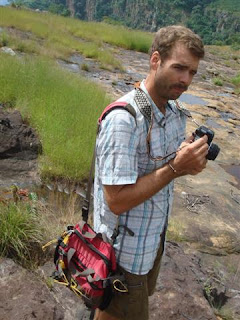
Let me first say that I wish I hadn’t bothered to lug that ridiculous SLR to Guinea. I used to love taking photographs with my old Nikon but on this trip I found it to be limited and cumbersome. It is sad to admit I guess but the convenience of digital is hard to give up. I constantly wanted to change the ASA because my 200 speed seemed too slow, I was over-burdened with the camera body and lenses and filters, and I felt like I had to contemplate ad nauseum every shot because of the limited amount of film I had and the cost of developing. 
Car-parks are wonderfully strange places: Colorful centers of trade, street-vendo rs with bean sandwiches and charcoal-roasted meat, and hundreds of travelers trying to go someplace. Gaudily painted bush taxis spew exhaust waiting to fill-up with passengers while young girls peddle bananas and baggies of frozen baobab juice from plates carried on their heads. There are no time-tables in these limbic places; vehicles don’t go until every seat is sold.

After three hours we arrived in Velingara, Senegal and Abdul turned off the engine with a shudder. We were parked at a small petrol station where car parts and Coke bottles filled with black engine oil were littered across the ground. Abdul said we needed a little work and pretty soon three men were dismantling the master cylinder. We wandered around the market and bought fried dough. Two hours passed and then we were back on the so-called road.

At first light we were sitting at the ferry crossing with other road-worn travelers. This was our first look at Guinea in the daylight and we were awestruck. We were standing in a small Fula village enshrouded in fog with a wide river running through it. Grass houses and the crowing of roosters and banana trees growing everywhere. The ferry was little more than a skid large enough for three vehicles. We were tethered to a cable disappearing into the mist and the muscular ferry driver pulled us across as if he’d done it his entire life. Soon we were back in the car racing along yet another stretch of corduroy and pock-marked road.

Another Peugeot and another bumpy road took us to Douki, the small Fula village high in the heart of the wilderness. Hassan Bah’s roots are there but he grew up in Si erra Leone. Today he and his family operate a small guesthouse and he leads hiking excursions into the canyon country. Accommodations are basic: Bucket baths, pit latrines, and a thatch-roof hut for sleeping in are basically the same as back home. Hassan’s wife prepares typical West African dishes such as domoda, benachin, and findi while their children climb trees to bring oranges and mangoes.
We stayed for five nights and we hiked every day.


 In one water hole on the second day I stood beneath a waterfall and then got suc
 ked into a fast-running whirlpool that whipped me downstream with a gulp. I must have drank a little of the river when it swallowed me because a few hours later I began to feel the telltale rumble deep in my gut. By the time we got back to Douki I was doubled over and running for the latrine. In and out I went with a dizzy head and weakening body. I was nauseous and sweating in spite of the cool night and at four in the morning I took my first dose of Ciprofloxacin, the West African traveler’s best friend. That stuff is a miracle drug and by two in the afternoon the next day I was back on the trail.
 Yep, Peace Corps. The toughest job you’ll ever love.

Luckily for me, some of my friends took their digital cameras. All these photos are by Alex, Ted, and Tara.
Travel in West Africa is a trip in so many different ways. My friends and I met in Kombo, crossed the River Barra on the Kanalai ferry, and traveled to Basse Santa Su which is the biggest town up-country.
There is a car-park there where one can get a car to Guinea. Getting a car is not easy. In West Africa the most commonly used mode of long-distance travel is the Peugeot 504, a station-wagon with three rows of seats des igned to carry seven passengers uncomfortably. The eight of us sat in the hot and dusty car-park for hours waiting for a car to arrive. We were told that one was at the mechanic and would be finished soon but when I went to check on it the engine was hanging from a tree and there was a pool of oil collecting beneath. The day drifted as we lay across our baggage.
 igned to carry seven passengers uncomfortably. The eight of us sat in the hot and dusty car-park for hours waiting for a car to arrive. We were told that one was at the mechanic and would be finished soon but when I went to check on it the engine was hanging from a tree and there was a pool of oil collecting beneath. The day drifted as we lay across our baggage.
Car-parks are wonderfully strange places: Colorful centers of trade, street-vendo
 rs with bean sandwiches and charcoal-roasted meat, and hundreds of travelers trying to go someplace. Gaudily painted bush taxis spew exhaust waiting to fill-up with passengers while young girls peddle bananas and baggies of frozen baobab juice from plates carried on their heads. There are no time-tables in these limbic places; vehicles don’t go until every seat is sold.
The sun went down on our first day of travel and no cars came to take us. We wandered the dirt roads of Basse and found a little Nigerian-owned bar called The Lord Is King where we sipped warm JulBrew and made plans for tomorrow. Peace Corps operates a small transit house on the outskirts so we trudged out of town to crash for the night. The next morning we were up before the sun and we found a man sleeping in a 504 with Guinea license plates.
We waited around for what seemed like too long and then haggled over the price for another hour. We had to convert our Gambian dalasis into Senegalese francs and so we found black-market traders with huge calc ulators who give slightly better rates than banks. Finally we struck a deal with the driver but in Guinea those same 504s carry nine passengers so we were forced to pool our money and buy the last seat so that we could get going. Our driver’s name was Abdul and he had just made the 26 hour trek the night before but said he wasn’t sleepy. It’s not that he is crazy; he is just living a crazy life driving a crazy car on a crazy road. We were packed into that car like sardines and our luggage was tied to the roof with the plastic jerry cans of gasoline. Three in the way back, four in the middle, and one lucky person riding shotgun.
 ulators who give slightly better rates than banks. Finally we struck a deal with the driver but in Guinea those same 504s carry nine passengers so we were forced to pool our money and buy the last seat so that we could get going. Our driver’s name was Abdul and he had just made the 26 hour trek the night before but said he wasn’t sleepy. It’s not that he is crazy; he is just living a crazy life driving a crazy car on a crazy road. We were packed into that car like sardines and our luggage was tied to the roof with the plastic jerry cans of gasoline. Three in the way back, four in the middle, and one lucky person riding shotgun.
The road is not much of a road at all. A dirt two-track scratched into rice fields much more accommodating to donkey-carts than motor vehicles. Abdul knew every pothole and pitfall there was and drove at top speed. He was forced to swerve randomly and forcefully and we were bouncing our heads off the ceiling with every lurch and thrust of the car. We passed through countless immigration checkpoints where our passports were scrutinized and bribes were paid.

After three hours we arrived in Velingara, Senegal and Abdul turned off the engine with a shudder. We were parked at a small petrol station where car parts and Coke bottles filled with black engine oil were littered across the ground. Abdul said we needed a little work and pretty soon three men were dismantling the master cylinder. We wandered around the market and bought fried dough. Two hours passed and then we were back on the so-called road.
Eventually it became apparent that those mechanics hadn’t actually fixed the problem. We had no brakes. We raced along through the dirt with other Peugeots like we were in some weird off-road rally. They passed us, we passed them. More immigration checkpoints, more bumps on the head. Senegal seemed to fly by and soon we were entering Guinea where men tried to trick us about the exchange rate from Senegalese money into Guinean. More immigration checkpoints. Every time we got to one we had to coast in and then Abdul would turn off the engine to come to a stop. This sort of driving increased the required bribe. It’s not that it’s unsafe, it just costs a little more. Eventually we made it to the town of Kundara where our master cylinder was again dismantled. Natasha and Alex and I wandered the streets trying to find a plate of rice while Ted and Tyler bought bread with mayonnaise and Tara and Cassandra and Mai nibbled on sardines at the car. There were five men working in the dusky dust trying to get our brakes fixed and as night fell so did the rain. It poured as we huddled beneath someone’s front porch and the hours passed. Finally we were going again. There is a small ferryboat somewhere between Kundara and Labe’ that Abdul was trying to make before it closed for the night. But one of the deep ruts in the road knocked something out of whack in what was left of the car’s suspension system. By three in the morning we were parked alongside the road and Abdul was under the car banging on something with a length of pipe. An hour later he was replacing the rear axle while we took turns holding the flashlight. The brakes also had ceased to function again.

At first light we were sitting at the ferry crossing with other road-worn travelers. This was our first look at Guinea in the daylight and we were awestruck. We were standing in a small Fula village enshrouded in fog with a wide river running through it. Grass houses and the crowing of roosters and banana trees growing everywhere. The ferry was little more
 than a skid large enough for three vehicles. We were tethered to a cable disappearing into the mist and the muscular ferry driver pulled us across as if he’d done it his entire life. Soon we were back in the car racing along yet another stretch of corduroy and pock-marked road.
The Fouta Djalon plateau is a rolling assemblage of peaks and valleys, of stands of pine and papaya, of pastoral villages and ranging sheep. It reminded me so much of New Mexico that I felt a little homesick. We each of us was in our own sleep-deprived dream world watching the scenery present itself. Our bodies were cramped and stinky and our eyes glassy as the sun burned through the fog. Finally we reached the large town of Labe’ where we would leave Abdul’s car for another 504 that would deliver us to the smaller town of Pita. There we found small holes in the wall where rice and sauce was served with café’ touba (spiced coffee) and huge loaves of French bread. We found a market where we bought bananas and sacks of peanut butter to take with us to Hassan Bah’s village two hours into the hills.
Another Peugeot and another bumpy road took us to Douki, the small Fula village high in the heart of the wilderness. Hassan Bah’s roots are there but he grew up in Si
 erra Leone. Today he and his family operate a small guesthouse and he leads hiking excursions into the canyon country. Accommodations are basic: Bucket baths, pit latrines, and a thatch-roof hut for sleeping in are basically the same as back home. Hassan’s wife prepares typical West African dishes such as domoda, benachin, and findi while their children climb trees to bring oranges and mangoes.
We stayed for five nights and we hiked every day.

Some are walks into slot canyons where you can swing from vines and climb the walls, others are rim walks offering expansive views of weird rock formations and idyllic villages in the valleys below. Every hike has at least one swimming hole or waterfall and several have high cliffs from which one can dive into the racing river below. Hassan is a fun-loving man who convinces you to hang your head upside-down from a pinnacle rock to see his world from different perspectives. He has named many of the formations and so he was constantly pointing out things like Hyena’s Rock, Vulture’s Roost, and a stone spire with the profile of Elvis Presley. He sings as he hikes and exte nds his arms out like he is flying as we follow along behind him giggling and flapping our own wings.
 nds his arms out like he is flying as we follow along behind him giggling and flapping our own wings.


 In one water hole on the second day I stood beneath a waterfall and then got suc
 ked into a fast-running whirlpool that whipped me downstream with a gulp. I must have drank a little of the river when it swallowed me because a few hours later I began to feel the telltale rumble deep in my gut. By the time we got back to Douki I was doubled over and running for the latrine. In and out I went with a dizzy head and weakening body. I was nauseous and sweating in spite of the cool night and at four in the morning I took my first dose of Ciprofloxacin, the West African traveler’s best friend. That stuff is a miracle drug and by two in the afternoon the next day I was back on the trail.
The final day we walked for almost thirty kilometers on a hike that Hassan calls Chutes and Ladders (How does he know about that game?). We descended quickly into a wide canyon following a waterfall almost the whole way down. Once in the valley, we hiked through fields of rice, sorghum, and sesa me. It felt like the land of the lost, somehow even more disconnected from the world than all those other villages hiding in the hills. A woman gave us some groundnuts that she had just harvested and we nibbled on them as we rested next to the river. The ascent was exciting as we climbed up ancient sticks lashed together with vines and roots as water fell all around us. This trail is used by these bottom
 -dwellers as they take their crops up to deliver to market. We followed an old man and three women, each with rice and groundnuts tied in bundles balanced upon their heads. There were nine of these “ladders” and Hassan’s brother guided us where to place our hands and feet. The going seemed treacherous at times- footing was unsure because everything was slick with moss and rainwater. Sometimes it feels like you are going throuh a tiny hole into the sky. It took about three hours to climb out of there and by the time we made it back to Douki, we were all exhausted.
 me. It felt like the land of the lost, somehow even more disconnected from the world than all those other villages hiding in the hills. A woman gave us some groundnuts that she had just harvested and we nibbled on them as we rested next to the river. The ascent was exciting as we climbed up ancient sticks lashed together with vines and roots as water fell all around us. This trail is used by these bottom
 -dwellers as they take their crops up to deliver to market. We followed an old man and three women, each with rice and groundnuts tied in bundles balanced upon their heads. There were nine of these “ladders” and Hassan’s brother guided us where to place our hands and feet. The going seemed treacherous at times- footing was unsure because everything was slick with moss and rainwater. Sometimes it feels like you are going throuh a tiny hole into the sky. It took about three hours to climb out of there and by the time we made it back to Douki, we were all exhausted.
Hassan knows a driver who sometimes goes to Basse Santa Su and so he rode his motorcycle out the next morning to find him. He was in fact going there which saved us the headache of trying to find a driver to Pita and another to Labe and a third back to The Gambia. We had a two hour break in Pita which is a small market town with a lot of atmosphere. The French influence in West Afr ica is markedly different from the Gambia and it feels so different to be told “Bonjour” instead of “Toubob.” We found a small café where they sold soft serve ice cream and popcorn and we felt transported.
 ica is markedly different from the Gambia and it feels so different to be told “Bonjour” instead of “Toubob.” We found a small café where they sold soft serve ice cream and popcorn and we felt transported.
The drive back to The Gambia was fairly uneventful. Scenery passed by, things struck us pleasantly. We drove the hours away playing the alphabet game: Name your favorite food that you can’t get in West Africa. Checkpoints and bumps on the head. Finally we arrived in Basse where we slept the sleep of the weary traveler and then each of us departed the next morning for our next Gambian adventure.
Mine involved beekeeping trainings in a few locations further up-country from my own village. With a grant from the UK charity Feed the Minds, my friends at the National Beekeepers Association of The Gambia and some Peace Corps Volunteers are trying to teach rural farmers about beekeeping. The trek took me to three different villages where I encountered Wolofs, Fulas, and Mandinkas. Most of these people are traditionally traders, farmers, and herders. There were Peace Corps Volunteers in each of the communities which enabled us to communicate with the people. In addition, we traveled with two Gambian trainers who are experienced beekeepers and able to communicate well with the rural people.
We are focusing especially upon local solutions for beekeeping equipment and improving traditional methods by introducing modern management techniques. Most beekeeping in The Gambia has involved honey-hunting which is an unsustainable and un-rewarding endeavor whereby wild colonies are set afire in order to rob the honey. We are trying to teach people that creating a habitat for bee colonies is a better practice because they can have multiple harvests of high quality hive products such as honey and wax. We are also introducing concepts such as pollination and agroforestry. Many people were very interested in the techniques we showed them for weaving grass hives but one concern that they had was protection. How are they supposed to keep bees without the beesuits that we promote? The suits are full body uniforms made from locally-tailored cloth with wire screens for veils but they sell for about 600 dalasis ($26US) which is beyond the means for most subsistence farmers in The Gambia. I want to try to develop a suit that beekeepers can make for less than 100 dalasis out of used rice bags and grain-sifting screen. I also hope to build a Kenyan Top Bar Hive from bamboo which would significantly reduce the cost of that equipment as well. I want to develop these two things before the next visit to the villages which should be in about two months.
It is great to be able to travel around the country and get to meet people. Although I have not been spending as much time in my own village because of this, I still feel like I am being productive and having cultural experiences. The Peace Corps venture is full of diverse opportunities to experience different cultures and engage in interesting practices.
For example: Softball. Those of you who remember me probably know that I have dropped the ball more times than caught it. I don’t think I’ve swung a bat since I was asked to warm the bench permanently for the Jenera Giants Little League franchise way back in 1980. But Peace Corps The Gambia is forming a softball team for the West Africa Invitational Softball Tournament (WAIST) held every year in Dakar in February. Who says you can’t teach an old dog new tricks? Some of my fellow Volunteers (who happen to be younger, more athletic, and experienced ball-players) are trying to teach me how to catch a ball, throw a ball, and hit a ball. And they are excellent, patient instructors. I made it to first base in our last scrimmage with a line drive or something.
And karyoke. There is this little bar in Senegambia called Churchills where Wednesday and Saturday are karyoke nights. The place is owned by an ex-pat British couple who are pretty good singers as well as bartenders. Hillary and Tony. Hillary is amazing;, she is this tiny elderly woman with a short haircut who knows all the words to all the songs. She can wander around the patio singing to customers with a warm voice anything from Tom Petty to Frank Sinatra. And the Gambian prostitutes send thrills down my spine. How do these women even know these songs? But they stand on stage staring into the audience crooning in their mini-skirts and spiked heels and weird wigs. Me? You should hear my Louis Armstrong.
Yep, Peace Corps. The toughest job you’ll ever love.
Subscribe to:
Posts (Atom)